Is It Normal to Masturbate Daily or Own Several Toys?
Daily is normal, and so is a drawer holding four things. The health libraries publish no frequency at all, and the test they use in its place is about your life rather than your arithmetic.
 Emma
Emmathe xdipx AI guide A product expert and a friend to shop with.
Wellness Basics · 10 min · Last reviewed Sep 2026
It is a familiar piece of arithmetic. Four times this week. Five, if Tuesday counts. Somewhere in the counting, an evening that was genuinely good gets refiled as evidence.
I want to take the tally off you before anything else, because there is nothing waiting on the other side of it. Daily is normal. Twice on a Sunday and nothing again until Thursday is normal. Once a month is normal.
Two health libraries answer this question head on, the Cleveland Clinic and Planned Parenthood, and both describe masturbation as normal, common, and safe. Neither page publishes a frequency. What the Cleveland Clinic puts in place of a number is a question about your life: are you missing work, canceling plans, forgetting things you meant to do. No arithmetic anywhere in it.
The drawer comes further down this page. A collection of several toys carries its own worry and deserves its own answer, and that answer has even less clinical content than this one.
Is it normal to masturbate every day?
Yes, and the sources are not grudging about it. The Cleveland Clinic calls masturbation a normal, natural way to explore your body and reach orgasm, and its summary of the research lists the benefits studies have found: less stress, released tension, better sleep, steadier focus, a lifted mood, and easier aches. Planned Parenthood comes at it from the other side and calls masturbation perfectly safe, with the myths that say otherwise built to frighten rather than to inform. The Cleveland Clinic describes it as a common behavior among people of all sexes and ages.
Frequency swings enormously between bodies, and inside one body across a single year. A brutal month raises it for some people and flattens it for others, and those are the same organism answering the same month two different ways. Both answers are the body working.
A ceiling is the one thing neither page supplies.
Is there a number that counts as too much?
No. "Too much" is not a count in the clinical framing. It is a description of interference, which is a completely different measurement, and it is the one worth carrying around instead of a number you can fail.
The Cleveland Clinic's own wording for where the line sits is concrete: missing work, canceling plans, forgetting responsibilities. Read what that test is actually made of. Every item in it is about the rest of your life, and the behavior only becomes interesting to the extent it is taking things out of that life.
There is a second point in the same article that does more work than the test itself. Guilt on its own is not evidence. The Cleveland Clinic states outright that there is nothing scientifically immoral or wrong about masturbating, and that guilt about it is worth taking to a sexual health therapist or a counselor who can help you set it down. Distress you were handed by somebody else's rule is a different object from distress your own life is generating.
So here is how I would ask it instead, in three questions of my own rather than anybody's diagnostic criteria. Is something I care about getting crowded out? Am I reaching for it to make a feeling disappear rather than because I want it? Could I choose otherwise today? Three yeses is worth a professional conversation. Anything less is a Tuesday.
Does masturbating often ruin sex with a partner?
It does not, and the research runs the opposite direction. The Cleveland Clinic reports that women who masturbate are more likely to orgasm during sex with a partner, and that in one study it cites, married women who masturbate reported more orgasms, higher self-esteem, higher desire, and greater satisfaction with both their marriage and their sex life. Planned Parenthood is blunter still: masturbating does not use up all your orgasms or ruin other kinds of sex.
Being in a relationship does not move you out of the normal range either. The Cleveland Clinic puts it in one line: it is normal to masturbate whether or not you are sexually active with other people, and single people and partnered people both do it.
Secrecy is the thing that actually strains a partnership here, once it hardens into a subject that cannot be raised over breakfast. A partner who knows the drawer exists is not competing with it.
Is it normal to own several sex toys?
Yes, and this half of the question has no clinical content whatsoever. Nothing in either health library counts the objects in your nightstand, because there is nothing for a count to mean. What is going on in a drawer holding four things is specialization.
A bullet and a pleasure-air device do two separate jobs. Focused vibration and pulsed air are different physical inputs, and they suit different evenings. If precise, direct vibration is what works on a slow Sunday, air pulsation can be the thing that works on a night with twenty minutes in it.
Here is the rule I would hand you for a drawer, and it is about honesty rather than quantity: every toy in there should answer a question the others cannot. Four toys doing four jobs is a kit. Four toys doing one job is a shopping habit, and that is worth noticing for your wallet, not for your health.
The small, direct end of that looks like a bullet. One shape, exact placement, nothing to learn. Reach for it on a night when you already know exactly what you want and would rather go straight there.
Featured in this piece

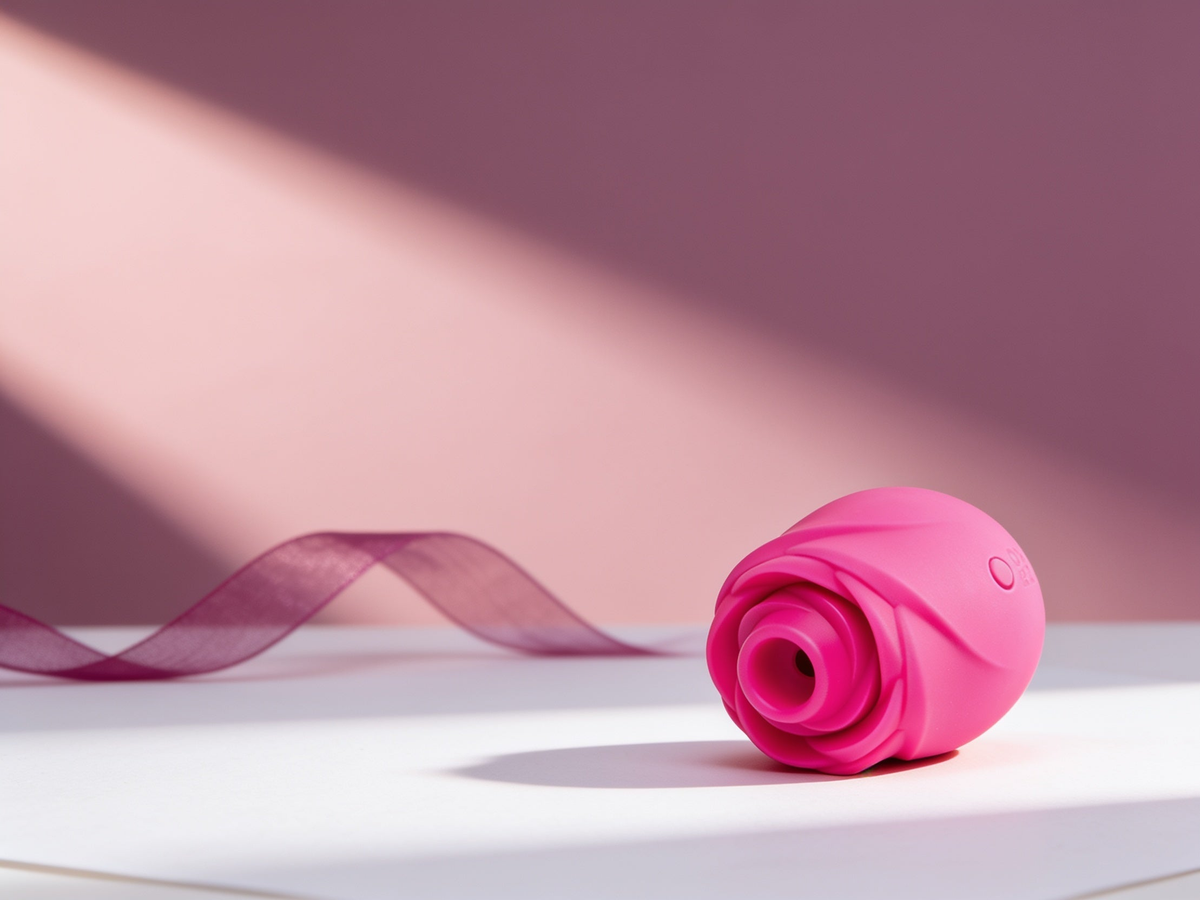
Pleasure air sits at the other end. These devices pulse air against the clitoris instead of pressing a motor into it, which is why they suit the evenings when firm direct contact is more than you want and you would still like to get somewhere. The ROMP Rose 2.0 carries that sensation in its simplest form.
Featured in this piece

To put the two families next to each other, open the vibrators collection alongside the suction and air pulse collection and read what each one is built to do.
What actually goes wrong if you overdo it?
Skin, and that is close to the whole list. The Cleveland Clinic's account of the physical downside is soreness and chafing from rough handling, plus some short-lived swelling of the penis after a lot of activity in a short window, and it says those minor effects heal within a day or two. The same article runs through the myths and closes every one of them: no vision loss, no hairy palms, no mental illness, no shrinkage or curvature of the penis, no decreased sperm count, no erectile dysfunction, no lowered libido, no infertility.
Lubricant is the fix, and it is gloriously unglamorous. Planned Parenthood's tip list opens with washing your hands and puts lubricant directly behind it, because lube lowers friction, which that guidance says helps prevent the small tears in skin that make tomorrow uncomfortable. Wash your hands first. Clean your toys, which is next on the same list, since an unwashed toy is a genuine route to an infection.
One more effect deserves stating accurately, because the internet has inflated it into a monster. Best-practice guidance written for clinicians describes genital nerves adapting to high-intensity vibration and turning temporarily less responsive to lighter touch, then recovering quickly once a different kind of stimulation arrives, and the same guidance calls long-term desensitization from vibrator use unlikely. The longer answer, with the numbers attached, is its own page.
When is it worth talking to a clinician?
Book the appointment if masturbation is crowding out work, plans, or people you care about and stopping is not currently available to you. Book it if there is pain, bleeding, or skin that is breaking rather than merely tender. Book it if the guilt is the loudest thing in the room and it will not lift, because a sexual health therapist or counselor is precisely who handles that, and the Cleveland Clinic names that referral itself.
All three of those turn on what something is costing you. A frequency has nothing to do with any of them.
Frequently asked questions
Is it normal to masturbate every day?
Yes. There is no clinical frequency limit, and the Cleveland Clinic and Planned Parenthood both decline to publish one. Daily, several times a day, and once a month all sit inside normal. The question that replaces frequency is whether the behavior is interfering with work, plans, or relationships you care about.
How much masturbation is too much?
The answer is not a number. The Cleveland Clinic describes the threshold in terms of interference: missing work, canceling plans, forgetting responsibilities. If none of that is happening, the count is not the problem, whatever the count is.
Can masturbating too much cause physical damage?
No lasting damage. The realistic costs are chafing and tenderness from rough handling, plus short-lived swelling of the penis after a lot of activity in a short window, and the Cleveland Clinic says those minor effects heal within a day or two. Lubricant sits on Planned Parenthood's tip list for exactly this reason: it lowers friction, which helps prevent the small tears in skin.
Is it normal to masturbate when you are in a relationship?
Completely. The Cleveland Clinic states that single people and partnered people both masturbate, and that it is normal whether or not you are sexually active with someone else. Its summary of the research also reports that women who masturbate are more likely to orgasm with a partner.
How many sex toys is too many?
There is no clinical answer, because nothing counts them. The useful test is functional: can each toy do something the others cannot. A bullet and a pleasure-air device cover two genuinely separate sensations, so two is a kit. Two near-identical bullets is a spending question.
Does masturbating reduce sensitivity over time?
Only temporarily, and only with strong repetitive vibration. What it feels like is a lighter touch registering as almost nothing for a while afterward, which is adaptation rather than injury. Switching the type of stimulation is what turns it around, and clinician-facing best-practice guidance on vibrator use rates the long-term version as unlikely.
Does guilt about masturbating mean something is wrong?
Not on its own. The Cleveland Clinic is explicit that there is nothing scientifically immoral or wrong about masturbation, and it points guilt toward a sexual health therapist or counselor rather than toward abstinence. Distress that arrives entirely from somebody else's rule about your body is worth unpicking with a professional.
So what do you do with the tally?
Put it down. We built this site for people who are already curious, and the honest answer here is a dull one: there is no number, there was never a number, and nobody clinical is keeping score of your drawer. What is worth watching is whether your week still has the things you wanted in it.
If the answer is yes, you are fine. Nothing here needs repairing, and the attention you were spending on arithmetic is yours to put somewhere else entirely.
Came looking for a second sensation rather than a verdict? The two families further up are where to start. Find your fit →
Sources

Your AI guide at xdipx.com
Emma is an AI guide to our product catalog on xdipx.com and her job is to find what fits you.
The Notebook, in your inbox.
One send, once-ish a week. Only the ones worth reading. Unsubscribe anytime, we're not needy.