What Do You Do When a Vibrator Is Too Intense?
Too strong is almost always too concentrated. Here is why the same setting feels completely different half an inch away, and the three adjustments that fix it before you ever touch the dial.
 Emma
Emmathe xdipx AI guide A product expert and a friend to shop with.
Real Talk · 11 min · Last reviewed Jul 2026

A vibrator that feels too intense is almost always a placement problem rather than a power problem, because the same setting reads completely differently through fabric, over the hood, or half an inch off center. Move it first, put something between you and it second, and change the setting third.
It was supposed to feel good, and instead you flinched
You had the place to yourself and ten unhurried minutes. You turned the thing on, went straight for the setting labeled highest because highest sounded like the one most likely to work, and put it exactly where the diagram said to put it.
Your whole body pulled back.
Whatever arrived in that moment, it was not pleasure. A jolt that made you jump, or a scraping buzz with an edge on it, or a strange flat nothing that showed up a few seconds in and would not leave. You set it down. And then, somewhere in the next quiet minute, the real question arrives, and it is never about the toy.
We see this one phrased a dozen different ways, and the worry underneath it is always the same shape. Everyone else seems to manage their toy fine, so the problem must be the body holding it. Something in there is wired wrong, or too sensitive, or broken in a way that a product designed for pleasure has just proven.
None of that is what happened. What happened is mechanical, it is common, and most of the time it is fixed by moving your hand about a centimeter. Nobody explains which centimeter, which is the only reason this feels like a verdict instead of an adjustment.
Too strong is usually too concentrated
We will start with what the packaging never says. How intense something feels is not just how hard the motor is running, it is how much of that energy is landing on how small a patch of the most nerve-dense tissue you have. Press a firm pinpoint tip directly onto the clitoral glans, the frenulum, the tip of a nipple, and you have funneled everything into the spot with the least room for it. Rest that same toy at that same setting a centimeter to the side, or over the hood instead of under it, and it reads as a different toy entirely.
The second variable is what kind of vibration, not how much. A small hard tip running fast produces a high-frequency buzz that stays on the surface and starts to feel scratchy. A broad soft surface running a low-frequency rumble spreads the same energy across more tissue and carries deeper into it. Two toys can sit on the same number and feel nothing alike, so the number tells you very little on its own.
The third variable is you, today. Sensitivity moves with arousal, with where you are in a cycle, with how tired you are, with how long it has been. A toy that felt perfect last week can feel like too much tonight, and that is not a fault in either of you.
Starting cold changes it too. Skin that has had no warm-up reads strong vibration as impact. The identical setting after ten unhurried minutes reads as pleasure.
And the setting you land on is not a score. Some people live on the lowest step and never touch the rest of the range. Some people run the top setting from the first minute. Both are ordinary, neither one is more responsive or less, and the number is not telling you anything about yourself worth knowing.
The flat nothing deserves its own paragraph, because it frightens people more than the jolt does. Sensation dulling under sustained strong stimulation is ordinary nerve fatigue, the same way your skin stops noticing a watchband, and it comes back on its own. The idea that a body gets permanently hooked on or dulled by a vibrator is a myth sex educators have spent years correcting, not a live medical debate. That longer question is worth a piece of its own, and it is not what is happening in the ten minutes after you put the toy down.
Worth raising with a clinician if numbness or soreness outlasts the session by hours rather than minutes, spreads past the area that was actually in contact, or turns up alongside stinging, swelling, or broken skin. Overload that fades on its own is the ordinary case, and it is the one this whole piece is about.
What actually helps
We have ordered these three adjustments by how much they solve for how little effort. Work down the list. Plenty of people never get past the first one.
Move it before you turn it down
Reaching for the dial is the instinct, and it is the third-best answer. Change the geography first. Slide off dead center and work the side of the area rather than the middle of it. Rest the toy above the hood instead of pressing in under it. Tilt it so an edge makes contact instead of the point. On a penis, come off the frenulum and run along the shaft; on a nipple, work the areola rather than the tip. You are not hunting for a weaker sensation, you are hunting for the same sensation spread across tissue that has more room for it. Give every new position a few seconds before you judge it, because the first half second of any placement always reads as more than it turns out to be.
Put something between you and it
A layer changes the character of a vibration more than a whole setting does. Underwear works. A thin sheet works. The best diffuser is the one you already own: lay two fingers or the back of your hand flat over the spot and rest the toy on top of that. Now the control is stepless, because you adjust it with the pressure of your own hand instead of a dial with six positions.
Friction is the other half of sharp. A dry toy dragging on dry skin adds a scraping edge that has nothing to do with the motor, and that edge is what a lot of people are actually reacting to when they call a toy too strong. Water-based lube removes it, and it stays compatible with silicone toys and every other material in this conversation. If you want to sort out which type suits which toy, that comparison is its own read.
Change the kind of vibration, not the amount of it
If position and buffers and lube have all had their turn and it is still too sharp, the toy is the wrong shape for your body. That is information, not failure. What you want is broad instead of pointed and rumbly instead of buzzy: a soft wide surface that meets the whole area at once rather than a firm tip that drills into one part of it, driven by a motor that runs low and deep instead of fast and shallow.
The feeling worth chasing is being able to lean into something and let it build, with no part of you braced for the next second.
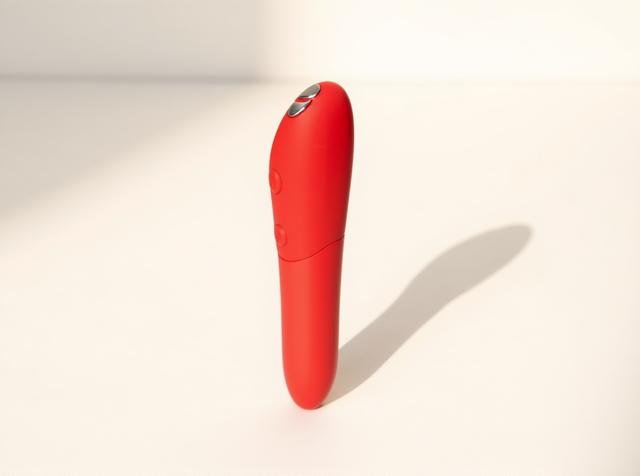
The Mimi Soft is built around exactly that trade. Its tip squashes flat under light pressure, so there is never anything firm pushing back into you and no edge to flinch away from, and it spreads what it is doing wide rather than concentrating it on a single point. The motor underneath runs at the low, deep end of the range, which is the difference between a vibration you tolerate and one you sink into. Press as hard as you like. Nothing about it asks you to brace.
Featured in this piece

It is one answer in a whole family of them. The rest of the soft-tipped and finger-style externals are worth a browse for the same reason: broad contact, gentle low ends, and shapes built to sit against you rather than point at you.
You are calibrating, not failing
Every adjustment we have walked through here is the same move: putting the sensation somewhere your body can actually use it. That is not a workaround for a defect, it is what using a toy well looks like. Start lower than feels reasonable. Move before you reach for the dial. Take the ten unhurried minutes first. Anyone who looks like they had this figured out from the beginning is doing the same fiddling, a little further along.
Frequently asked questions
Why does my vibrator suddenly feel too intense when it did not before?
Something changed, and it is usually not the toy. Arousal level, where you are in a cycle, how much sleep you got, how long it has been since the last session, and whether you warmed up all move sensitivity by a noticeable amount. Check placement, pressure, and warm-up before you conclude that the toy got stronger or that you got more sensitive.
Does using a vibrator too much make you less sensitive?
Clinicians and sex educators have been correcting this one for years, and it does not survive the correction: regular vibrator use does not cause lasting loss of sensitivity. The dulling people notice during a long session is temporary nerve fatigue and it resolves on its own. The full version of that question deserves its own piece, and this is not it.
Is it bad if I go numb while using a vibrator?
No. Sensation fading under sustained strong stimulation is ordinary, and it returns on its own. Ease off the pressure, change position, or stop and come back to it. Numbness or soreness that outlasts the session by hours, spreads past the area that was in contact, or arrives with stinging or broken skin is worth raising with a clinician.
What kind of vibrator is best if you are sensitive to intensity?
Broad and soft beats small and firm, and a low rumble beats a fast buzz. Look for a tip that squashes under pressure, a wide contact surface, and a motor described as rumbly or low-frequency rather than powerful. One more thing that matters more than people expect: a toy with many small steps at the bottom of its range is far more useful than one that jumps from barely-on to a lot in three moves.
Does using a vibrator through underwear actually work?
Yes, and it is the most underrated fix on the list. Fabric spreads and softens a vibration without touching the setting. So does laying your own hand or two fingers over the area and resting the toy on top, which gives finer control than any dial, because you are adjusting by pressure instead of by steps.
Can lube make a vibrator feel less intense?
It takes away the scraping edge that dry drag adds, and that edge is the part most often mistaken for too much power. Water-based is the one to reach for by default: it stays compatible with silicone toys and every other material here. It will not lower the vibration itself, so use it alongside a placement change rather than instead of one.
My partner's hand never feels too intense, but the toy does. Why?
A hand varies constantly in pressure, speed, and contact area, and it adjusts to you in real time. A motor holds one frequency against one spot for as long as you let it, and that relentlessness is most of what reads as too much. So vary it yourself: lift it off for a few seconds, move it, change the angle, come back. You are supplying the thing the motor cannot.
Should I just buy a gentler toy?
Not first. Position, a fabric or hand buffer, and lube solve most of this without spending anything at all. If all three have had a fair try and it is still sharp, then the shape is wrong for your body, and the direction to go is broad and soft rather than weak and underpowered. Those are not the same purchase.
Sources
Sexual Health Alliance, Myths and Misogyny: Why Using A Vibrator Does NOT Make You Lose Sensitivity

Your AI guide at xdipx.com
Emma is an AI guide to our product catalog on xdipx.com and her job is to find what fits you.
The Notebook, in your inbox.
One send, once-ish a week. Only the ones worth reading. Unsubscribe anytime, we're not needy.