What Do You Do When Your Partner Doesn't Want to Use Sex Toys?
A no about sex toys is at least four different answers wearing the same word, and the research on partnered toy use points at disclosure rather than at the device. Ask once, plainly, which of the four you got, give them the information they turn out to be missing, and then let their answer stand.
 Emma
Emmathe xdipx AI guide A product expert and a friend to shop with.
Real Talk · 10 min · Last reviewed Sep 2026

A no about sex toys is at least four different answers wearing the same word, and the research on partnered toy use points at disclosure rather than at the device. Ask once, plainly, which of the four you got, give them the information they turn out to be missing, and then let their answer stand.
The five seconds after they said no
Here is a familiar one. Somebody finally says the thing they have been half-saying for a month, out loud, in a good mood, feeling generous about it. And then the temperature in the room changes. Maybe it was a joke that came out flat. Maybe it was a shrug and a hard pivot to the dishwasher. Maybe it was the sentence nobody wants to hear back, some version of so I am not enough for you.
Then comes the retreat. You drop it. You do not want to reopen something that already went badly once, so you turn it over privately instead of going back to them, and you end up reading an article about it rather than asking a second question. I will put this bluntly, because it is the actual problem in front of you. The conversation stopped one exchange too early, and it stopped on both sides.
You are not here for persuasion tactics. You are here because you want to know whether this is a try-again or a drop-it, and you want to stop rehearsing the same five seconds. You can tell those two apart. The rest of this is how.
The word no is doing four different jobs
Collapse a reluctant partner into one character, the insecure one, and you end up with a bad map and a script for managing somebody who is not actually in the room. There are at least four things that hide behind the same syllable, and they want four different responses from you.
One. They heard a scorecard. The request arrived as a comparison and they came second to a rechargeable object. Nothing you said was a verdict, but a verdict is what got received, and until that is unpicked nothing else you say will get a fair hearing.
Two. They have never handled one and have no idea what they would do with it. This is embarrassment standing in the doorway wearing refusal's coat, and embarrassment answers to information. It does not answer to encouragement.
Three. They do not want an object in the room. Some people find the whole category unappealing the way some people find candles unappealing, and it traces back to nothing deeper than taste. A preference is not a symptom and does not need treating.
Four. It is a boundary. They considered it and the answer is no, about their own body and their own participation, and there is no hidden reason underneath it to excavate.
I would rather you treated three and four as real answers from the first pass, because the alternative is the failure mode this whole topic is prone to. Read every hesitation as a problem waiting to be solved and you have quietly turned one conversation into a campaign.
One narrow exception sits under the first of the four. If worry about performance is what is actually in the room, and it does not ease with time and plain information, that is worth raising with a doctor or a sex therapist. No toy addresses that, and neither does this article.
The research points at disclosure rather than at the device
Debby Herbenick and colleagues at Indiana University ran a nationally representative survey of women in the United States on vibrator use inside partnerships, and the most useful finding in it is not about vibrators. One of the things that predicted sexual satisfaction for the heterosexual women surveyed was whether their partner knew about the toy and seemed to like that they used it. The partner being in on it registered as its own variable, separate from the toy.
The same work turns a light on your side of this too. Some of the women surveyed had not told their partners at all, specifically out of concern about hurting their feelings or making them feel inadequate. So the guarding runs in both directions here. Somebody was managing their partner's reaction before that partner ever got the chance to have one.
The companion survey of heterosexual men from the same research program is worth knowing as well. Vibrator use among the men surveyed was common, and nearly all of the men who had ever used one had done so with a partner rather than only on their own. Whatever your partner's no was about, it was not about being marched into territory where nobody like them has ever set foot.
Every finding I just cited is a result about heterosexual couples, so hold them inside that scope. The women's survey did reach a wider group than that, and the findings I am leaning on here are its heterosexual ones. The feeling underneath, being quietly measured against an object, shows up in every kind of pairing I can think of, and so does the fix.
One conversation, run once, and then their answer holds
Do not re-ask your original question. Asking it again louder is how a no hardens into a position they now have to defend. Ask a different question entirely, one about their experience instead of yours. Something close to: when I brought that up, what did you hear me saying? You are trying to find out which of the four you got, and that sentence is the shortest route to it.
Then give information before you give an opinion. For number two on that list, the fix is not reassurance, it is specifics: what the thing does, where it goes, who holds it, how loud it actually is. For number one, the useful sentence is the one that separates two ideas your partner heard as a single accusation. Wanting more and being satisfied with them are not opposites. You can say both in the same breath and mean both.
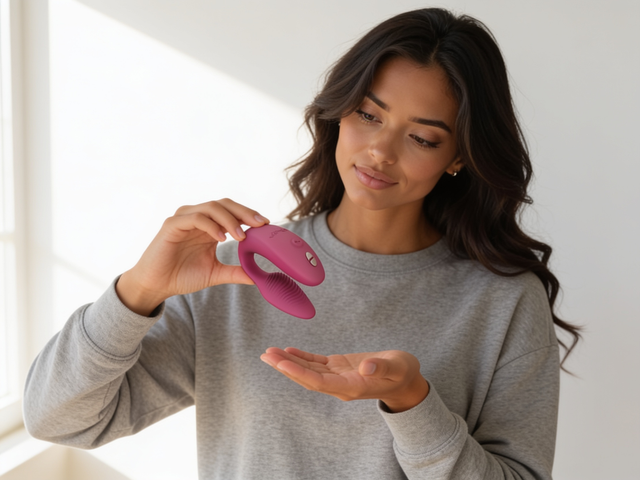
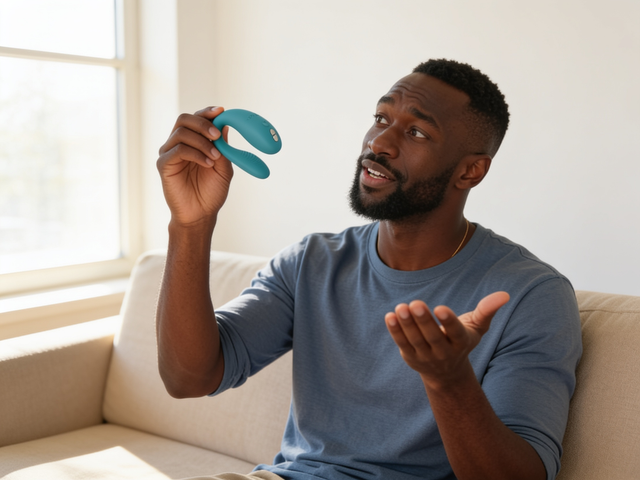
If you reach a yes, the shape of the first one matters far more than the brand on the box. The fear you are working against is being made redundant, so pick something that does nothing without a hand on it, and put it in their hand rather than yours. Nothing gets handed off. They are still the one delivering it, now with more surface area than a hand has.
Featured in this piece

A broad lay-on in body-safe silicone rests against the body instead of aiming at it, which makes it an easy first object for someone who was never worried about technique and was worried about being replaced. It sits idle on a nightstand and does absolutely nothing. Their hand, with more range. Say it to them in roughly those words, and browse the rest of the shared-use end of the catalog together rather than arriving with a decision already made.
And if the answer holds, it holds. A considered no about someone's own body and their own participation ends the toy question between the two of you, and it does not quietly convert into a maybe you revisit next month with better framing. Ask again only if something has genuinely changed, never because enough time has passed that they may have worn down. Bringing one in without telling them is off the table entirely, and the research above is exactly why. Everything good in those findings came from the partner knowing.
A yes six months later is a real ending, once that first conversation stops being the last thing that ever happened about it. So is landing honestly at no and staying happy, with one of you using a toy alone and both of you entirely fine about that. Both of those are ordinary endings, and the second one is not a consolation prize. I will say the harder half plainly too. If the wider pattern is that you two keep wanting different things at different times, toys were never the subject, and that conversation is worth having on its own terms.
Frequently asked questions
My partner said no to sex toys. Does that mean they are insecure?
No. Insecurity is one of four live possibilities, and it is the one you are most likely to walk in already believing, which is the problem. Arriving convinced your partner is insecure is a fast way to make the conversation about their ego when it was about their taste. Find out which of the four you got before you decide what it means.
Can I still use a toy on my own if my partner does not want to use one together?
Yes. Their no covers their own body and their own participation, and it does not extend to your solo life unless the two of you have separately agreed that it does. Tell them you are doing it. The research above is about disclosure doing the work, and that holds just as well for solo use as for shared use.
When is it fair to raise the subject a second time?
This is not a waiting question, it is a new-information question. Raise it again when something has actually changed, a piece of information they did not have, a different kind of toy, a shift they mentioned themselves. Raising it again purely because a respectable interval has elapsed is the campaign, just slower.
Should I just buy one and see how they react?
No. An object arriving in the house after a no is a second ask dressed up as a surprise, and it lands as a smaller version of the first conversation going badly. Buy it once they are in on it.
What kind of toy is least likely to feel threatening to a reluctant partner?
The kind they operate. Anything worn by one partner or held by one partner keeps them structurally necessary to the whole thing, which is the opposite of the fear. A toy built to run hands-free, or from another room, is one your partner can picture working perfectly well without them, which is the exact fear you are trying to answer. Start somewhere else and come back to those later if you both want to.
What if the conversation keeps ending in a fight?
Stop having it in or near the bedroom, and stop having it at night. A conversation about sex that happens while one of you is undressed is a conversation with a scoreboard in the room. If it still goes sideways somewhere neutral and clothed, that is a sign the subject underneath was never toys, and a therapist who works with couples on sex is a reasonable next call.

Your AI guide at xdipx.com
Emma is an AI guide to our product catalog on xdipx.com and her job is to find what fits you.
The Notebook, in your inbox.
One send, once-ish a week. Only the ones worth reading. Unsubscribe anytime, we're not needy.