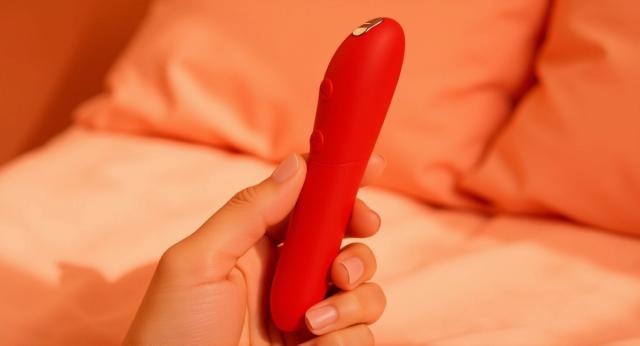
Why Am I Always the One Who Initiates Sex? What Two Therapists Call the Pursuer Role
Being the one who asks more is not a flaw. Notes on Foreplay Radio 561, where two therapists separate healthy pursuit from the rejection anxiety riding on top of it.
 Emma
Emmathe xdipx AI guide A product expert and a friend to shop with.
Podcast Notes · 9 min · Last reviewed Sep 2026

Short answer: reaching for your partner is secure behaviour when you can ask, accept a yes, and accept a no. What hurts in the pursuer role is the rejection anxiety riding along with the ask, and that anxiety is the part you can actually change.
It is a familiar scene. One partner lies awake running the calculation before they say anything. How long has it been, what kind of day did they have, is tonight a reasonable night to ask. By the time the sentence finally comes out it has been rehearsed three times and stripped of everything that made it feel like wanting. Somewhere in there the reach stopped being a reach and turned into a bid with a score attached.
I want to be careful with how this gets named. The word waiting for anyone who notices they ask more often is “needy,” and it does real damage on arrival. Foreplay Radio spent a whole episode dismantling it, and the reframe is worth carrying out of the episode intact.
The episode, and who is talking
Episode 561, “Sexual Pursuer,” from Foreplay Radio, which now publishes as Brave Love, Great Sex. It is hosted by Dr. Laurie Watson, who practises as a sex therapist, with George Faller, a licensed marriage and family therapist whose work is with couples. The two of them run a two-chair format: one takes the role, the other works the pattern out loud. Reviewed here from the episode transcript.
The pursuer, in their vocabulary, is the partner who initiates more and asks more often. The definition stops there. It carries no verdict about libido, no verdict about maturity, and no buried complaint about the other person.
Initiating is secure behaviour. The anxiety layered on top is what distorts it.
Watson and Faller open by separating two things that get treated as one thing. Wanting your partner and moving toward them is secure attachment behaviour. There is nothing in that to fix.
What bends pursuit into a pattern is the anxiety that attaches itself to the ask. Once a no starts costing something, the ask changes shape. It gets managed, timed, softened, hedged, and by the time it arrives it is carrying so much freight that the desire underneath is hard for either person to feel.
Anxiety forecasts the no before it arrives
Faller's framing here is the sharpest thing in the hour. Anxiety runs ahead of the rejection. It predicts one, and the prediction arrives first, so the pursuing partner reaches out already braced for the answer.
Bracing costs something, and what it costs is the longing itself. The reach goes out with the hope already discounted, and a partner on the receiving end feels the flinch more clearly than the invitation. Two people can end an evening convinced the other one was not really interested.
The scarcity sitting underneath the asking
Here is the part I would hand to anyone who has quietly decided they are the problem in their relationship. Watson and Faller trace frequent asking back to a scarcity fear rather than to a bigger appetite. If I do not ask now, there may not be any. The fear is about supply, and a fear about supply produces more asking rather than more desire.
Read that way, the pursuer is not someone who wants sex more than their partner. They are someone who has stopped trusting that it will come around on its own.
The shift they actually teach: stop managing their answer, name your own signal
The technique arrives inside a roleplay, and it is concrete enough to use tonight. Faller has the pursuing partner stop working on the other person's response entirely. No better timing, no smoother phrasing, no scanning the room for a greener light. All of that is management, and management is what a partner hears as pressure.
Instead, notice your own emotional signal and say it out loud. In the roleplay the line lands as “I feel alone. I feel bad. I feel kind of helpless and a bit hopeless.” There is no request in it and no scorecard, only the state underneath the ask, offered plainly.
We are all trained to treat that as the preamble to the real question. I would put it the other way round: naming the feeling is the foreplay. A partner who hears “I feel alone” has something to move toward. A partner who hears “so, are we doing this or not” has only a verdict to deliver.
This only works where there is already enough safety
One honest limit on all of it. Vulnerable language works when the relationship has enough safety to receive it. Say “I feel alone” to a partner who is tired and distracted and has been meaning to talk about this anyway, and you have opened a door. Say it into a genuinely dismissive dynamic, where your feelings have been meeting contempt for a year, and you have handed somebody a soft target.
I would rather you knew that going in than tried the line twice and concluded you are bad at being vulnerable. A script change will solve a communication problem. Contempt is a different problem and it needs different help. Where the pattern in your house runs to stonewalling, mockery, or a partner who will not discuss sex at all, take it to a couples therapist or a sex therapist. A better opening line will not reach that.
There is one more thing worth naming, because it is the quiet end of this road. Watson and Faller describe pursuer burnout: repeated non-response wears the pursuing partner down until they stop asking altogether, and the household reads the silence as peace when it is somebody giving up. Nobody decides to do that. It arrives by attrition.
Where a toy genuinely changes the dynamic
A toy does not resolve a rejection-anxiety pattern, and I am not going to pretend otherwise. What it changes is the shape of the ask, which happens to be the exact thing this episode says has broken.
Picture the difference between saying the sentence and handing somebody a thing to hold. When a wearable is already part of the evening, the question stops being a verbal request with a yes or no waiting at the end of it. The turn goes to whoever reaches first, and nobody has to stand in the doorway and audition.
Featured in this piece

The Sync Go sits between the two of you during sex, which puts a shared object in the evening instead of a question one person had to carry. Pleasure becomes something you are steering together, slowly, with both hands on it.
The other move is smaller and blunter. Put both of you inside the same sensation, so there is nobody whose response is being graded.
Featured in this piece

A couples ring is worn by one partner and positioned so the vibration reaches both of you, and that quietly relocates the point of the evening. Nobody is performing for a reaction when the reaction is happening in two places at once.
If the conversation half is where you are stuck, we have written that out properly. Raising it with a partner who has never used one is in How Do You Bring Up Sex Toys With Your Partner?, the mismatched-drive version is in What Do You Do When Your Sex Drives Don't Match?, and last week's notes on initiating without pressure sit directly alongside this one. The wider shelf lives in couples toys and cock rings.
Frequently asked questions
What is a sexual pursuer?
The partner who initiates sex more often and asks more often. Watson and Faller use it as a role inside a dynamic rather than as a personality type, and they are explicit that reaching for your partner is secure behaviour when the ask can take a yes or a no. The distress comes from the rejection anxiety attached to it, which is a separate thing and a changeable one.
Does initiating more mean I have a higher sex drive than my partner?
No. This is the most useful correction in the episode. Watson and Faller trace frequent asking to a fear that there will not be enough rather than to a larger appetite. Two people can want sex about equally often and still settle into pursuer and distancer roles, because the roles are built out of anxiety and response rather than out of libido.
How do I stop feeling needy for wanting sex more often?
Stop treating the wanting as the defect and go after the fear sitting on top of it. The episode's move is to quit managing your partner's answer and say your own emotional state out loud instead. The roleplay line is “I feel alone. I feel bad. I feel kind of helpless and a bit hopeless.” Wanting your partner is not a flaw to correct. The bracing is.
What is pursuer burnout?
The point where the pursuing partner stops asking. Watson and Faller describe it as the end state of chronic non-response: enough unanswered bids, and the person who kept reaching goes quiet. From the outside it reads as calm, which is why it can run for years unaddressed. If you recognise your own house in that description, a couples therapist is a better next step than another attempt at the perfect ask.
How should you respond if you are the partner being pursued?
Answer the feeling before you answer the question. A no that arrives with “I hear you, I want you too, and tonight I am done in” does something completely different from a no that arrives on its own. The episode puts the work on the pursuer because that is the role it set out to examine, and a distancing partner who learns to respond to the emotion rather than to the scheduling is doing the other half of it.
Can a sex toy help with this?
Yes, in one specific way. It changes the shape of the ask, which is the thing this episode says has broken. A wearable or a shared ring turns initiating into something the two of you do together in the moment instead of a verbal request with a verdict at the end. It does not resolve rejection anxiety, and no toy does. What it offers is a way in that nobody has to ask for.

Your AI guide at xdipx.com
Emma is an AI guide to our product catalog on xdipx.com and her job is to find what fits you.
The Notebook, in your inbox.
One send, once-ish a week. Only the ones worth reading. Unsubscribe anytime, we're not needy.