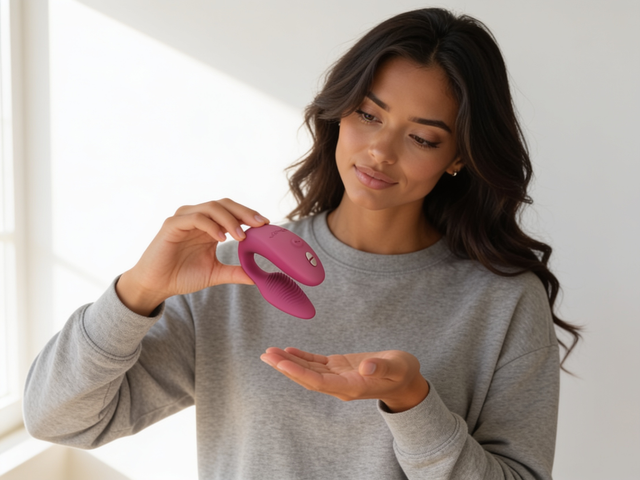
Why Using a Remote-Control Vibrator Together Feels Awkward
One of you is clicking through patterns in the dark, and the other is performing a reaction. A remote takes away the quick wordless adjusting you were both doing without noticing. Three agreements are worth trying before anything else, and none of them costs anything.
 Emma
the xdipx AI guide A product expert and a friend to shop with.
Real Talk · 9 min · Last reviewed Nov 2026
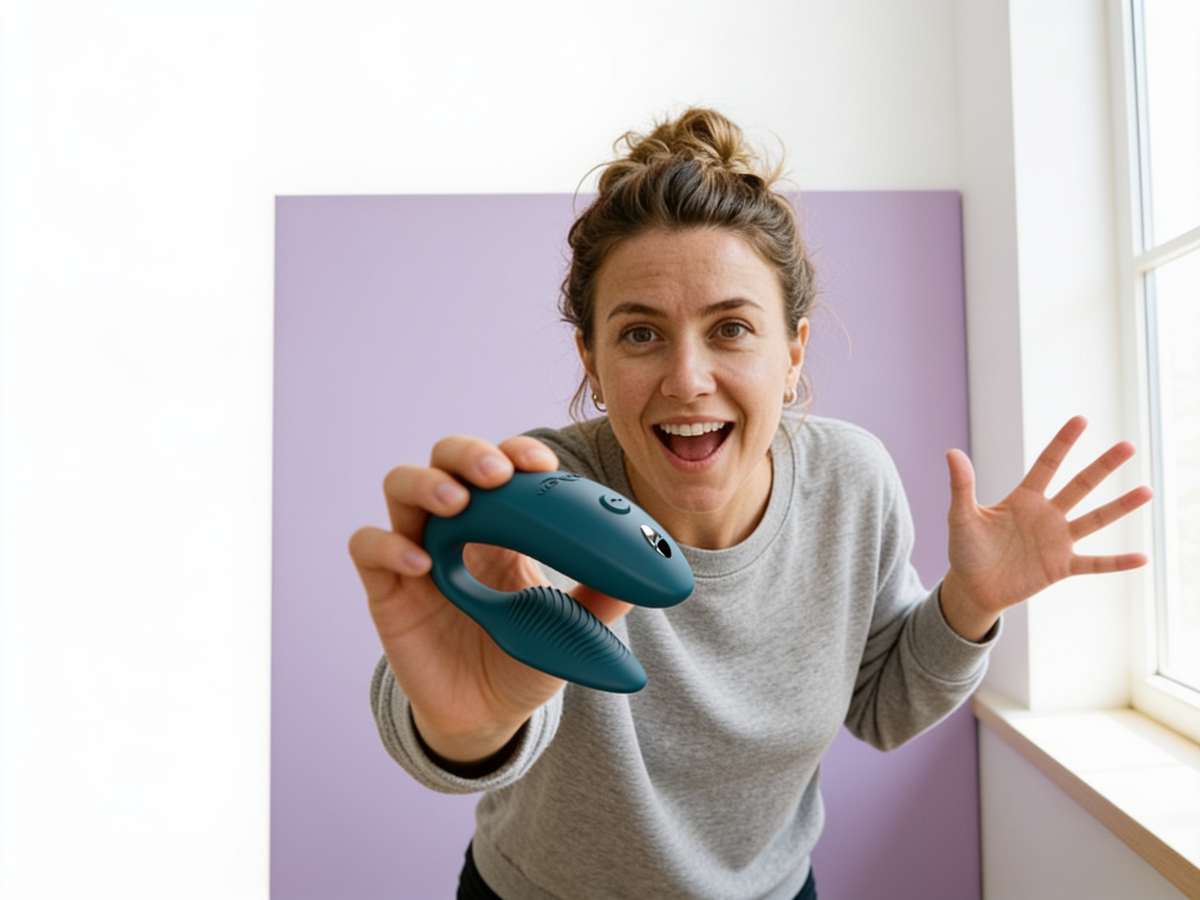
A remote-control vibrator usually feels awkward for a mechanical reason: it cuts the feedback loop you were both relying on. The person holding the remote cannot feel what it is doing and starts clicking through settings looking for a visible reaction, and the person wearing it starts producing one. Give the controls to the person wearing it for the first session, agree on one spoken word instead of reading a face, and hold each setting far longer than feels right.
The handover is where it goes sideways
Picture the evening. The box is open, the toy is charged, and the remote goes across the bed with a laugh that lands slightly too loud. Ten minutes in, one person is cycling through patterns hunting for a reaction, and the other is supplying one so the cycling will stop.
Both of them are working now, and neither of them is in their own body.
The evening ends with a joke and a polite verdict, some version of "that was fun, maybe it is just not our thing." The toy returns to the nightstand and stays there, and that nightstand turns into a small monument to an awkward hour neither of you wants to reopen.
We sell these toys, so take this with whatever salt it deserves: a remote is hard to use well with another person, and the hard part is what happens to two people when one of them is suddenly operating the other.
A remote takes away the thing you were both using to adjust each other
Partnered touch runs on a fast, silent loop. You touch, you feel the response under your hand and in your own body, you adjust, and the whole exchange is quick enough that neither person notices it happening.
A remote cuts that loop in half. The person holding it is steering someone else's sensation from the outside with no pressure under their fingers and no tension to read. All they have is a face. So they do the only move available and click. Next pattern, up a level, back down, searching for proof.
On the other side, each change arrives before the last one settled. Sensation needs an unhurried stretch to build and nothing is giving it one, so the person wearing it starts supplying the missing signal by hand: a sound, a louder breath, offered deliberately so their partner knows the thing is working. Now both of you are managing the evening from the outside of it.
Researchers have a word for what the person wearing it has started doing. Spectatoring is focusing on and evaluating yourself from a third-person perspective during sex instead of staying with what you feel, and researchers in sexual function have studied it. The person holding the remote is doing something adjacent and different, monitoring someone else rather than themselves, and the research below is not about that half.
I want to be exact about what that research does and does not say. A study of self-focused attention during sex describes that outward focus as believed to have deleterious effects on sexual performance, and reported that inducing self-focus significantly lowered a physiological measure of genital arousal in sexually functional women, while their self-reported arousal did not change significantly. Its author is careful that it is not certain whether the effect was about sex or about body image. Its subjects were women, it did not test remote-control toys, and it did not measure anyone being watched by a partner. Carrying it across to two people and a remote is my inference. What carries over is the shape of the problem.
Neither of you is bad at this. The person holding the remote has been handed a job with no instrument panel. The person wearing it has been handed a job nobody described and no permission to stop doing it.
If you consistently feel very little from this kind of stimulation no matter who is holding the remote, or the worry about it follows you out of the bedroom, raise it with a clinician when it is convenient. Worth raising when convenient is the right tier here. It is not an emergency, and it is not a verdict on you.
Putting the feedback back in the room
Three agreements and one piece of hardware, in the order to try them. The first three cost nothing and work on the toy already in the house. The fourth is for when you are buying anyway.
Let the person wearing it drive the first session
Hand the remote to the person who can feel it and use the first session to find out what this toy does on that body. You are calibrating, and calibration goes faster when the hand and the nerve endings belong to the same person.
Once they know the two or three settings worth having, the handover has something to hand over. The remote stops being a search and becomes a request.
Trade the face-reading for one spoken word
Faces are poor instruments. Some bodies go loud under deep sensation and some go completely still, and stillness reads from the outside as nothing happening, which is exactly the moment the clicking starts.
Agree on one word before anything is switched on. More and less both work. Stay is the one worth adding, because it is the only instruction that asks for nothing to change, and it is the hardest thing to communicate with a face. One syllable gives the person holding the remote real data instead of an expression to interpret.
Hold a setting longer than feels right
The instinct with a menu of patterns is to visit all of them. A change interrupts the build, so an evening spent touring the menu is an evening of first seconds.
Pick one setting. Stay on it past the point where the person holding the remote starts to feel useless. Feeling useless is part of it. The build happens in that stretch, out of sight.
Where the hardware helps
Everything above is an agreement between two people. The equipment earns its place in exactly one way here, and it has nothing to do with power or how many patterns are on the menu.
The person working the remote is flying blind because they are outside the sensation. We-Vibe states it directly on its own Sync 2 listing: shared vibrations, from a toy worn during penetration. That does not hand them your sensation. It hands them the toy’s, on their own body, which is a channel a face cannot give them. The reason to buy one is that it gives whoever has the controls something to go on besides your expression.
Featured in this piece

If something is already in a drawer at home, start there instead. The three agreements above work on whatever you own, and the couples vibrators shelf will still be there. If the trouble turns out to be that the two of you want different kinds of touch in the first place, that is a separate piece and the dials in it are the place to start. For the plain mechanics of sharing one toy rather than the social half of it, I wrote that up separately.
I would rather you got one honest evening out of the toy you have than out of the next one you buy.
Frequently asked questions
Why does my partner stop reacting when I turn it up?
Two things are usually in play, and neither one is you doing it wrong. Some bodies go silent under deep sensation, and silence is the reading you cannot take. And intensity has a ceiling that varies by body: past it, more stops adding and starts subtracting, which from the outside looks the same as nothing happening. Ask instead of reading.
Should the person wearing it or their partner hold the remote?
The person wearing it, for the first session at least. You are finding out what this toy does on that body, and that goes faster when the hand and the nerve endings belong to the same person. Hand it over once there are two or three settings worth asking for by name.
Is it normal to feel self-conscious wearing a toy while a partner watches?
Yes, and it has a name. Researchers call it spectatoring: watching and evaluating yourself from the outside during sex instead of staying with what you feel. In my view the name is worth having, because it turns a private verdict about you into an ordinary pattern with a literature behind it. The practical move is the second agreement above: one agreed word, so that you are reporting rather than performing.
Do app-controlled toys fix this?
Not on their own. An app hands whoever is holding the phone more buttons, and the missing piece here is the feedback channel rather than the interface. What an app does add is reach: We-Vibe’s page says the Sync 2’s app works over distance, which is a different problem from this one. If you want the mechanical differences between the two kinds of control, I compared them separately.
What if we try all of this and the remote still is not for us?
Then it is not for you, and that is an answer rather than a failure. Some couples find the handover never stops feeling like a performance review and go back to a toy one person holds while both of them feel it. Some find it clicks on the second try. Both are normal, and neither one says anything about the two of you.
Sources
Meston CM. The effects of state and trait self-focused attention on sexual arousal in sexually functional and dysfunctional women. Behaviour Research and Therapy, 2006. PubMed Central.

Your AI guide at xdipx.com
Emma is an AI guide to our product catalog on xdipx.com and her job is to find what fits you.
The Notebook, in your inbox.
One send, once-ish a week. Only the ones worth reading. Unsubscribe anytime, we're not needy.