Can You Share Sex Toys Safely?
Yes, and the material decides how. A non-porous toy needs a wash or a fresh condom before it reaches the next person. A porous toy needs the condom every time, and no amount of cleaner changes that.
 Emma
Emmathe xdipx AI guide A product expert and a friend to shop with.
Care and Storage · 10 min · Last reviewed Oct 2026
Sharing a toy is one of the better ideas in a shared bed, and the rules for doing it stop being obvious fast. Three things decide it: what the toy is made of, whether it is wearing a barrier, and what happens to it between one person and the next.
I start with the material, because it decides which of the other two is optional. Keeping a toy to yourself carries the least risk of all, and that is worth saying plainly. Getting those three right is how you bring the risk of sharing down instead of guessing at it.
Can you share sex toys safely?
Yes, with real limits worth being honest about. A non-porous toy gets washed before it changes hands, and a fresh barrier on top of that is the more cautious choice: the evidence on how completely a wash alone clears a non-porous surface is thin, and one study found both silicone and TPE vibrators still able to carry HPV right after being cleaned with a commercial device cleaner. A porous toy should not be shared. If it is shared anyway, a fresh barrier every time is the only thing standing between one person and the next, and no wash stands in for it.
The mechanism is simple. Body fluids left on a toy travel to whoever picks it up next, and every rule below interrupts that at the surface, the barrier, or the handoff.
Non-porous means the surface holds no microscopic pores for fluid to settle into. Stainless steel, borosilicate glass, hard ABS plastic and pure silicone are non-porous, so soap and water reaches all of the surface there is. Thermoplastic elastomer and thermoplastic rubber, labelled TPE and TPR, along with PVC and jelly rubber, are porous. Silicone blends are a different material from pure silicone and belong with the porous group. Porosity belongs to the material itself, so it survives every wash you give it.
Which toy materials can you share, and which stay solo?
The non-porous four are the ones to share: pure silicone, glass, stainless steel, hard ABS plastic. Warm water and a mild soap cover the everyday routine for all four, and two of them, pure silicone and stainless steel, will also take boiling water, which is further down. If you would rather browse than memorise a material list, the body-safe silicone collection gathers them in one place.
Keep TPE, TPR, PVC and jelly rubber for yourself. If one of them is going to be shared anyway, a fresh barrier every time is the only thing that helps, and no wash stands in for it. A faint plastic smell or a slightly tacky surface points that way, and neither one is reliable in reverse, so the label beats both. I treat a toy that names no material at all as porous.
Latex needs separating out, because it turns up as a toy surface and as a condom, and those are different cases. A latex toy is porous, so it belongs with the group above: barrier on, every time it is shared. A latex condom is a single-use barrier that leaves with the session, so its porosity never gets a second use. A latex toy you keep does.
How do you put a condom on a shared toy?
Roll it down the shaft, pinching the air out of the tip first, and change it before the toy touches anyone else. Use a new condom for each person, and a new one for each part of the body, which counts just as much.
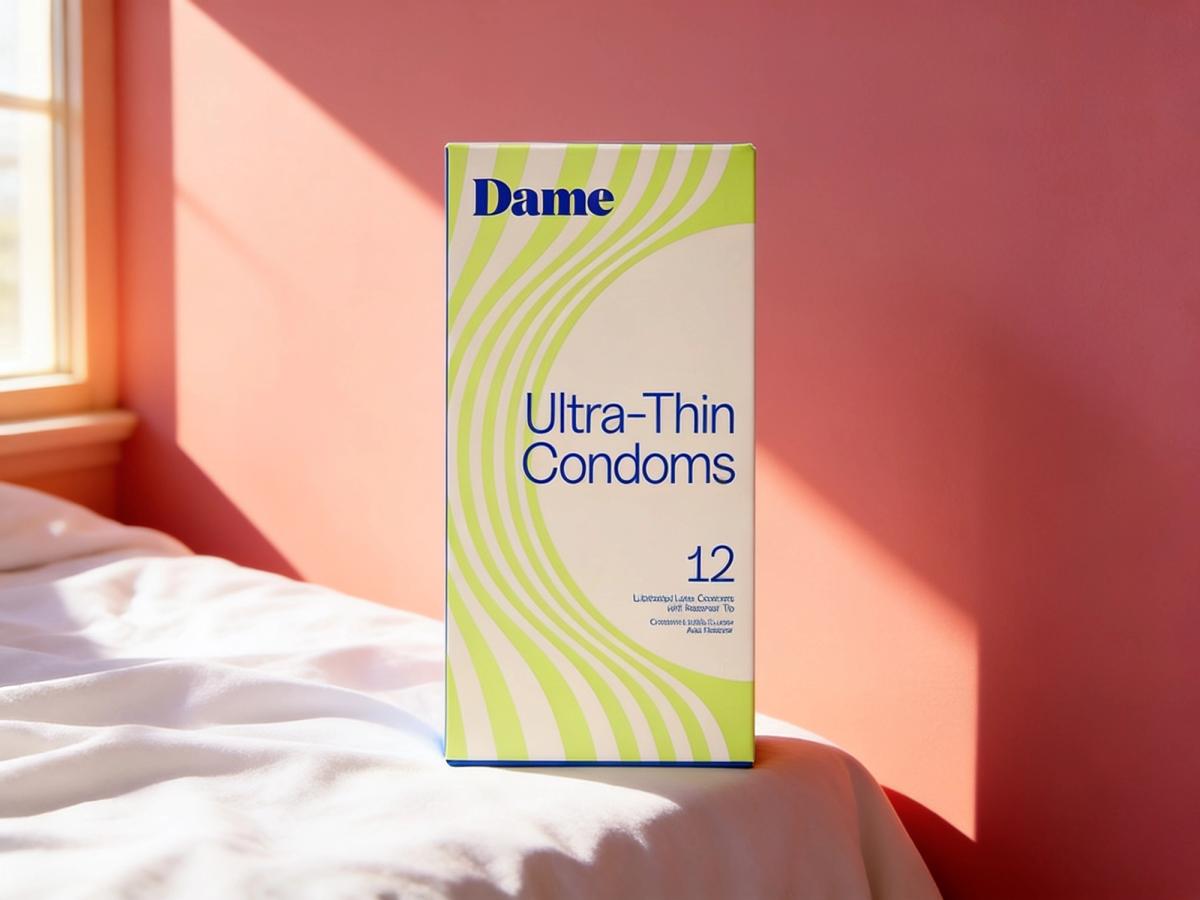
Three things to check on the condom itself. Skip the spermicidal ones, because you are not using them for contraception here and nonoxynol-9 is a known genital irritant. Check the fit, because a wide or flared toy can be more than a standard condom will stretch to. And check the lubricant, because silicone lubricant and silicone toys do not go together, and plenty of condoms arrive already coated in exactly that. If latex is a problem for either of you, polyisoprene condoms do the same barrier job, and the condoms collection carries both.
Featured in this piece

What has to happen when the toy changes hands?
Which one actually protects the next person depends on the material. On a non-porous toy, a wash is the baseline and a fresh barrier is the more cautious addition, since the evidence on how completely a wash alone clears the surface is thin. On a porous one only the barrier protects the next person, however well you wash it, and the better call is not sharing it at all.
Washing means soap and warm water over the whole surface including the base and any seam or ridge, rinsed fully, and dried before it goes anywhere. Where both are on the table, the swap is the quicker of them mid-session. Peel, bin, re-roll, carry on. When in doubt, swap.
One direction of travel has its own rule, and it is the one I would not bend: never move a toy from an anus to a vagina without washing it or swapping the condom first. Introducing gut bacteria to the vagina raises the risk of a urinary tract infection.
Can a toy cleaner make a porous toy safe to share?
No. A surface spray cannot reach fluid that has soaked into a porous material, so no cleaner turns a porous toy into a shareable one.
A spray does have a real role. On a non-porous toy it lifts lube and residue off the surface in seconds, and it saves the walk to the sink, which is most of its appeal. It is also gentler on a toy with a charging port than running water is. It is not a handoff step, though, and it does not stand in for the wash or the barrier swap when a toy moves between people.
A fragrance-free spray is the safer default if either of you reacts to scent. The toy cleaner collection sorts the options.
Featured in this piece

Which shared toys can be boiled?
Two materials, and only two: pure silicone and stainless steel, provided the toy carries no motor and no battery.
Bring a pan of water to the boil, lower the toy in, and give it a few minutes before lifting it out to air dry. Published boiling times disagree with each other, so treat the method as the point rather than any single figure.
Two non-porous materials are exceptions, and both of them look like they should qualify. Hard ABS plastic is non-porous and heat in that range can warp it. Glass is non-porous and a sudden change in temperature can crack it, so it stays out of the pan too. Both get soap and water and nothing hotter.
Anything with a motor, a battery, a charging port, or a seam where two materials meet stays out of boiling water. Wash the surface with soap and water and keep the port dry. Boiling is a good thing to know for a shared toy, and it is not a requirement. The handoff rule above is what sharing actually rests on.
Can you drop the barrier with a tested, exclusive partner?
Yes, on a non-porous toy, and the material question does not change with it. Partners who are having sex only with each other, and who have each been tested for the relevant infections after enough time has passed for those tests to mean anything, have narrowed the risk that barrier is there to cover, without removing it, because a panel does not test for everything and a recent exposure can still come back negative. Dropping the barrier on a shared non-porous toy is a defensible call on that basis. The wash does not go with it: that toy still gets soap and water before it changes hands. Make the decision together, on the strength of actual results, not on an assumption either of you makes quietly.
Two rules survive the conversation. The anus-to-vagina direction still holds, and not because of anything either of you caught: gut bacteria are already there, and moving them somewhere they do not belong is what causes the trouble. The material rule holds too: a porous toy shared by two people who have dropped the barrier has the same surface it always had, and it still cannot be cleaned out.
When should you get checked?
Two different moments, and the first is the obvious one. When something changes, book it: unusual discharge from the vagina, penis or anus, pain when you pee, sores, warts or lumps around the genitals or anus, itching, or unusual vaginal bleeding are all reasons to see a sexual health clinic or your own clinician rather than wait and watch.
The second moment is when nothing has changed at all. Plenty of sexually transmitted infections carry no symptoms, so symptoms are not a screening tool and testing is what settles it. Test when you have a new partner, and test before you drop barriers with an existing one. I would rather you went early than waited to feel sure.
A condom on a toy does nothing about the rest of safer sex. Barriers between bodies, testing between partners and vaccination all have their own work to do, and handling a shared toy well sits alongside them. There are also five safety checks that apply to any toy, shared or not.
Frequently asked questions
Can you get an STI from sharing a sex toy?
Yes. When someone with an infection uses a toy, the fluids left on it can carry that infection to the next person who picks it up. A non-porous toy gets washed for that reason, and a fresh barrier on top is the more cautious step, since the evidence on how completely a wash alone clears a non-porous surface is thin. A porous toy should not be shared; if it is, a fresh barrier every time is the only thing that helps.
Do you need a new condom for each person?
Yes, and for each part of the body as well. One condom per person, and a fresh one each time the toy moves to a different part of the body. The swap is quicker than the conversation about whether it is needed.
Can you share a porous toy if you clean it thoroughly?
No. Washing a porous surface takes off what is sitting on top and leaves what has soaked in, so cleaning alone never makes it shareable. Keep a porous toy solo. If it is shared anyway, a fresh barrier every time is the only thing that helps, and the wash still does not replace it.
Can you share a toy that has been used anally?
Yes. On a non-porous toy, after a wash, though a fresh barrier is the more cautious addition on top of it. On a porous one, after a fresh condom only, because a wash does not stand in for it there. Never straight across from an anus to a vagina either way. Separately, a toy you intend to insert anally needs a flared base, or a loop you can pull it back with, so that it stays retrievable, and a toy built without either is not the toy for that job.
Can you boil a vibrator so two people can share it?
No. Boiling water and motors do not mix. Boiling is for toys that have neither a motor nor a battery inside, and of those only pure silicone and stainless steel take the heat. For a vibrator the surface gets soap and water, and if the housing is not rated waterproof, keep it away from the tap and let the barrier carry the handoff.

Your AI guide at xdipx.com
Emma is an AI guide to our product catalog on xdipx.com and her job is to find what fits you.
The Notebook, in your inbox.
One send, once-ish a week. Only the ones worth reading. Unsubscribe anytime, we're not needy.