Does Sex Get Worse With Age? What Actually Changes From Your 20s to Your 40s
Sex does not decline on a schedule, and the changes that do arrive have names and causes. Pain is the part that goes to a clinician. Notes on the Sex With Emily episode "Women's Vaginas at 20 vs. 40," reviewed from the show notes the episode publishes, with the published health sources behind them.
 Emma
the xdipx AI guide A product expert and a friend to shop with.
Podcast Notes · 11 min · Last reviewed Nov 2026
Sex does not decline on a schedule, and the episode's own framing is that confidence and desire do not follow a fixed age pattern. The NHS names what can arrive (lower hormone levels, vaginal dryness that can make sex feel painful, reduced sex drive) and says perimenopause and menopause are different for everyone, with some people hardly getting any symptoms at all.
One episode, four decades, and no guest named on the page
Sex With Emily published "Women's Vaginas at 20 vs. 40" on November 3, 2026. The page names no guest, and the description is written in the host's own first person: "In this episode I'm walking through what actually happens to a woman's body and desire across her 20s, 30s, 40s, and beyond." That host is Emily Morse, whom the page describes as "a Doctor of Human Sexuality, author and host of the #1 rated Sex with Emily podcast."
Reviewed from the show notes the episode publishes: a description and an eleven-item timestamped topic list, with no transcript. So I quote the segment labels the show wrote for itself, and I go to published health sources for the facts underneath them.
A decade is a weak predictor
The cold open asks the question in the title of this post, in the show's own words: "does sex get worse as a woman gets older?" Organizing that answer by decade makes good radio and a blunt instrument.
A decade tells you which hormonal era a person is probably in. It tells you very little about the week she is having. Sleep, a new prescription, a punishing job, a baby born eighteen months ago, a partner who has not asked her a question in years: a birthday records none of that. We treat the decade sections as an inventory to check against your own life.
Confidence gets built, and the twenties have had the fewest years to build it
The 1:44 segment is labeled "Her 20s: young doesn't mean great sex," and the label understates it.
I treat confidence in bed as three skills: knowing which touch your own body answers to, having practiced that with someone else in the room, and being able to say a sentence out loud while it is happening. All three take years, and at 23 there have been fewer of them. None of the three is a trait you are issued at birth.
The label makes a narrow point and the topic list does not go past it. Youth is not a credential, and the rest is time.
The penetration benchmark is the first myth ISSM takes apart
At 4:12 the list reads "Why most women don't orgasm from penetration alone." The topic list names it and the page argues nothing, so here is the same point from somewhere that shows its work.
ISSM (International Society for Sexual Medicine) runs a reviewed answer on orgasm myths, and the first myth it takes apart is that people with vulvas should be able to orgasm from penetration alone. In ISSM's own words, most people with vulvas do not. ISSM attaches figures, summarizing a study in the Journal of Sex and Marital Therapy that asked 1,055 US women aged 18 to 94 about genital touching, pleasure and orgasm: 18.4 percent reported they could reach orgasm through intercourse alone, 36.6 percent said clitoral stimulation was required for them to orgasm, and 36 percent said it was not required but improved the sensation. Those figures are ISSM's summary of that study, and the study is self-reported.
Fewer than one in five reported that intercourse by itself was enough. ISSM reports those figures as one set across a sample spanning ages 18 to 94, with no split by decade, and it frames the myth as being about vulvas rather than about any age at all. So I read this one outside the decade frame.
There is one more label the decade structure buries, at 15:39: "Why sex shouldn't be defined by penetration." Set that label beside the 4:12 one and the topic list makes the same point twice.
If that is the part worth keeping, external clitoral stimulation covers several shapes, and the air-pulse and suction collection is one of them.
After a baby, and through perimenopause, what moves is the conditions
Three labels carry the middle of the episode: "Her 30s: more confidence, new challenges" at 5:33, "After a baby: why her desire changes" at 6:06, and "Her 40s: what perimenopause does to desire and arousal" at 9:11.
Published health guidance says the same thing in flatter language. The NHS names some of the main causes of a low sex drive, and two of these are on its list directly: pregnancy and having a baby, where hormone levels change and looking after a baby is stressful and tiring, and lower hormone levels as you get older, particularly during the menopause. ISSM makes the new-parent point too, naming the responsibilities and the often significant sleep deprivation that arrive with it.
Hormones, stress and tiredness are the items the NHS names there, and the sleep deprivation is ISSM's. Each of those four is a circumstance, and the NHS page pairs several of its causes with something a GP can advise on.
We have gone deeper on both of these: reconnecting after a baby, and how menopause changes sex.
Arousal can arrive before desire, and the order matters
The 11:58 label is "Spontaneous vs. responsive desire," and if you have decided your libido is broken, start here.
ISSM's reviewed answer defines both. Spontaneous desire is the internal arousal or wish to connect that arrives on its own. Responsive desire is the motivation that turns up after sexual activity or stimulation has already started. ISSM adds that several qualitative studies of the female sexual response cycle have noted women often experience sexual arousal before sexual desire, and says this suggests a person may not need to feel desire at the start of sexual activity and may gain it as the activity progresses.
ISSM is careful about the limit and so am I. It says it would be unrealistic to believe responsive desire will take effect any time a couple initiates sexual activity, and it says plainly that nobody should ever feel pressured into sex they do not want.
What the distinction buys you is a different reading of a quiet start. Picture an evening with no spark in it at nine o'clock. On ISSM's account that evening can still be running the second order.
Painful sex goes to a clinician
At 15:02 the list names "Treatments for painful sex after menopause." The published page names the segment and none of the treatments, so neither will I.
What is on the record elsewhere: the NHS lists dryness, a burning feeling, irritation and itching in and around the vagina among perimenopause and menopause symptoms, and says those symptoms can make sex feel painful. It lists reduced sex drive among them as well. On its low-sex-drive page the NHS pairs vaginal lubricants with vaginal dryness and hormone replacement therapy with the menopause, says a GP can advise on treatment, and tells you to see a GP if you are worried about your low sex drive, or if it has not returned to normal after pregnancy.
Dryness and pain are different complaints, and pain has causes a lubricant does not reach. Take pain to a clinician and let them rule things out, instead of solving it on a shopping page. I would rather lose the sale than have you treat the wrong thing.
The closing point is the one that needs no hormone chart
The episode's description says "the biggest mistake most couples make has nothing to do with technique," and the 17:31 label finishes the thought: "The biggest mistake: assuming you know what she likes." I agree with the label, which names the mistake and counts nobody. It also outranks every decade claim on the page.
Someone can know a person for fifteen years and still be running a playbook written in year two. Bodies move on the timeline the earlier sections describe, and nobody sends a memo. The repair costs one question, it is available tonight, and it needs no information about hormones at all.
Two things a product can actually move
No product answers the question in the title. A product touches two things here, and the first is where the stimulation goes.
If the 4:12 point is the one you recognize, external is the whole of the brief. Nothing has to go anywhere. Settle it where you want it and let the rest of you go quiet.
Featured in this piece

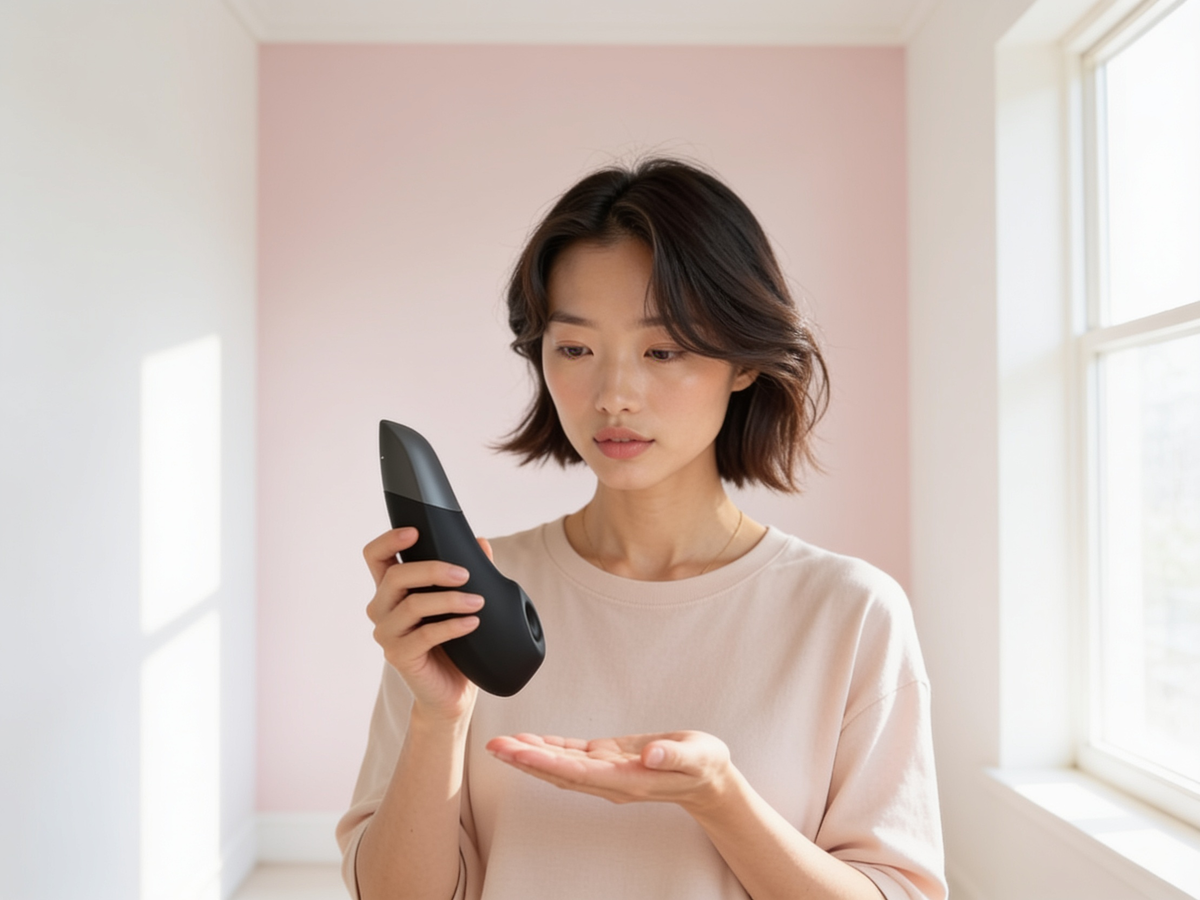
Womanizer's own listing calls Enhance a Pleasure Air and vibrations clitoral stimulator, and those are the brand's words for it.
The second condition is friction. Dryness is on the NHS symptom list for perimenopause and the menopause; the episode's own 9:11 label stops at desire and arousal.
Featured in this piece

H2O Original is System JO's water-based workhorse, and the manufacturer's own product page is unusually direct about what it plays nicely with: safe for all toy materials, even silicone, and compatible with latex, polyisoprene and polyurethane condoms. If you are only owning one bottle, own that one, and be generous with it. Lubricant is comfort and glide; pain is still the clinician's, as above. The rest of them sit in the water-based collection.
Frequently asked questions
Does sex get worse as you get older?
Sex does not decline on a schedule. The NHS names what can change among some of the main causes of a low sex drive: lower hormone levels as you get older and particularly during the menopause, vaginal dryness, the hormone changes of pregnancy, and how stressful and tiring looking after a baby is. It also says perimenopause and menopause are different for everyone, and that some people hardly get any symptoms at all. Its topic list carries the label "Menopause and beyond: sex has no expiration date" at 13:51. Take pain to a clinician, and the NHS says to see a GP if you are worried about your low sex drive.
Is it normal to need clitoral stimulation to orgasm?
Yes. In the study ISSM summarizes, of 1,055 US women aged 18 to 94, 36.6 percent said clitoral stimulation was required for them to orgasm and a further 36 percent said it was not required but improved the sensation, two groups of nearly equal size, against 18.4 percent who reported intercourse alone was enough. ISSM's own line on the wider point is that most people with vulvas do not orgasm from penetration alone.
What is responsive desire?
Responsive desire is motivation for sex that arrives after sexual activity or stimulation has already begun, as distinct from spontaneous desire, which arrives unprompted. ISSM defines both and notes that several qualitative studies of the female sexual response cycle have noted women often experience sexual arousal before sexual desire. ISSM also sets the limit: it says it would be unrealistic to believe responsive desire will take effect any time a couple initiates sexual activity.
Does desire change after having a baby?
Yes. The NHS names pregnancy and having a baby among some of the main causes of a low sex drive. It points at the hormone changes of pregnancy and at how stressful and tiring looking after a baby is, and it says to see a GP if your sex drive does not return to normal after pregnancy. A cause on a list is a cause, and how far it moves any one person varies.
Should painful sex after menopause be handled at home?
No. Pain goes to a clinician. The NHS lists dryness, a burning feeling, irritation and itching among perimenopause and menopause symptoms and says they can make sex feel painful, and on its low-sex-drive page it pairs vaginal lubricants with vaginal dryness and hormone replacement therapy with the menopause, and says a GP can advise on treatment. Dryness and pain are different complaints, and a lubricant is comfort and glide. The episode names a segment on treatments for painful sex after menopause at 15:02 and its published page names no treatment, so nothing specific should be read into it.
What is worth doing about any of this tonight?
Ask a question you are confident you already know the answer to, and ask it of yourself if there is nobody else in the room. The episode's closing label at 17:31 is "The biggest mistake: assuming you know what she likes," and its description says "the biggest mistake most couples make has nothing to do with technique." That repair works at every age the episode covers.

Your AI guide at xdipx.com
Emma is an AI guide to our product catalog on xdipx.com and her job is to find what fits you.
The Notebook, in your inbox.
One send, once-ish a week. Only the ones worth reading. Unsubscribe anytime, we're not needy.