How Does Menopause Change Sex, and What Helps?
Menopause changes sex on two separate tracks, tissue comfort and desire, and each one has its own fix. Here is what is actually happening, what to do about each half, and where a clinician belongs in it.
 Emma
Emmathe xdipx AI guide A product expert and a friend to shop with.
Real Talk · 10 min · Last reviewed Aug 2026
Menopause changes sex along two separate tracks: falling estrogen thins genital tissue and reduces natural lubrication, and spontaneous desire gets quieter while responsive desire, the kind that follows arousal rather than preceding it, most often keeps working. Those tracks run on different timelines and answer to different fixes, so solving the dryness will not restore the wanting, and restoring the wanting will not solve the dryness.
Nothing announced itself
It is a familiar scene. An ordinary weeknight, an unhurried hour, real interest in the room, and a body that needs a longer approach than it needed a couple of years ago. Nothing hurt. Nothing failed. Something moved.
Then a second thing turns up, usually later and usually on its own schedule. The wanting stops arriving unprompted. It no longer files itself into a Tuesday evening the way it once did, and waiting around for it to show up on the old terms produces nothing but waiting.
Somewhere between those two, the question stops being mechanical. I will answer the larger one first, because it is the one actually driving the search. No, this is not the point where you stop being someone worth reaching for. Your estrogen is falling. Your desirability is not on the same chart.
One more thing before the physiology. Desire that never arrived on its own, at any age, is its own ordinary starting point. So is a menopause that came from surgery or cancer treatment rather than from the calendar. So is the menopause of a trans man or a nonbinary person with ovaries, where the tissue changes run the same course whoever is living it. Desire is the part that does not carry over: testosterone therapy has its own separate effect on wanting, so the tissue half of this piece applies directly and the desire half is a different conversation. All of that sits inside this topic rather than in a footnote to it.
Two changes, not one
Estrogen does two different jobs on its way out, and collapsing them into one problem is how you end up fixing the wrong thing and concluding that nothing works.
The first job is tissue. Genital tissue thins, produces less natural lubrication, and loses elasticity. Clinicians group these changes under the name genitourinary syndrome of menopause, and the name earns its length: the bladder and the urethra sit in the same estrogen-sensitive neighborhood, so urgency, frequency, and repeat urinary infections often arrive in the same season as the dryness. That grouping is the reason a flat "use more lube" answer misses most of what a person is actually noticing.
The second job is desire, and it runs on its own clock. Sex researchers separate spontaneous desire, which arrives unbidden, from responsive desire, which shows up after arousal rather than before it. What researchers describe shifting in midlife is the proportion between the two: the spontaneous kind goes quiet, and the responsive kind most often keeps working. Sometimes the responsive kind goes quiet as well. That happens, it is documented, and it deserves a proper medical conversation rather than getting filed under not trying hard enough. Wanting sex less spontaneously is not the same as wanting sex less. Read that sentence twice.
Variance here is enormous, and the variance is not the problem. Some people notice the tissue changes at forty five. Plenty notice nothing at all until well past fifty five. Some sail through the desire side and get hit hard by the dryness. Some get the exact reverse. All of it is ordinary.
Worth seeing a clinician when pain during sex does not ease after a few weeks of consistent lubricant or moisturizer use, when there is any bleeding during or after sex at any point past menopause, when urinary urgency or repeat infections arrive alongside the sexual changes, when vulvar itching, burning, or skin changes appear that do not track with ordinary dryness, or when the drop in desire comes packaged with persistent low mood. None of those are cause for panic. All of them are things a clinician has real tools for, and the comfort side of this is among the more responsive things they treat. Raising it gets you further than riding it out.
The part nobody types into the search box
The searchable question is about dryness. The question underneath it is whether the person you have been is being quietly retired.
That fear takes a specific shape for anyone whose sense of themselves ran partly on being the one who wanted it. If desire was your evidence, and the evidence goes quiet, the conclusion writes itself: maybe it was never you, maybe it was hormones doing the work the whole time. I would rather you took the other reading. Hormones set the volume. They never wrote the music.
Say that out loud to a partner, or to nobody, and you have already done more than anything on this site will do for you. It also does not require you to have worked out what is happening first.
What actually helps
Three things, and the order matters.
Stop treating it as one problem
I want you to split these two apart before you buy anything. Comfort and desire answer to different interventions. Solve one, expect the other to follow, and you get the impression that neither worked. So handle the comfort question on its own terms and on its own schedule. Handle the desire question on its own terms, with time rather than product. Running the two together is how a pair of solvable problems turns into a verdict on your body.
Glide at the moment, moisture on a schedule
These are two different products doing two different jobs, and the distinction is the single most useful thing on this page. A lubricant goes on when sex is happening and its job is friction. A moisturizer goes on regularly whether or not anything is happening, and its job is the tissue's ordinary day-to-day comfort. Reaching only for the first one, only in the moment, treats an all-week condition as a five-minute one.
The lubricant half is easy, and you can find it anywhere. The half almost nobody mentions is the other one. What you actually want is to stop tracking this at all, to have comfort go back to being the background condition it used to be rather than something you negotiate with halfway through an evening, and that is the job the scheduled half quietly does.
Featured in this piece

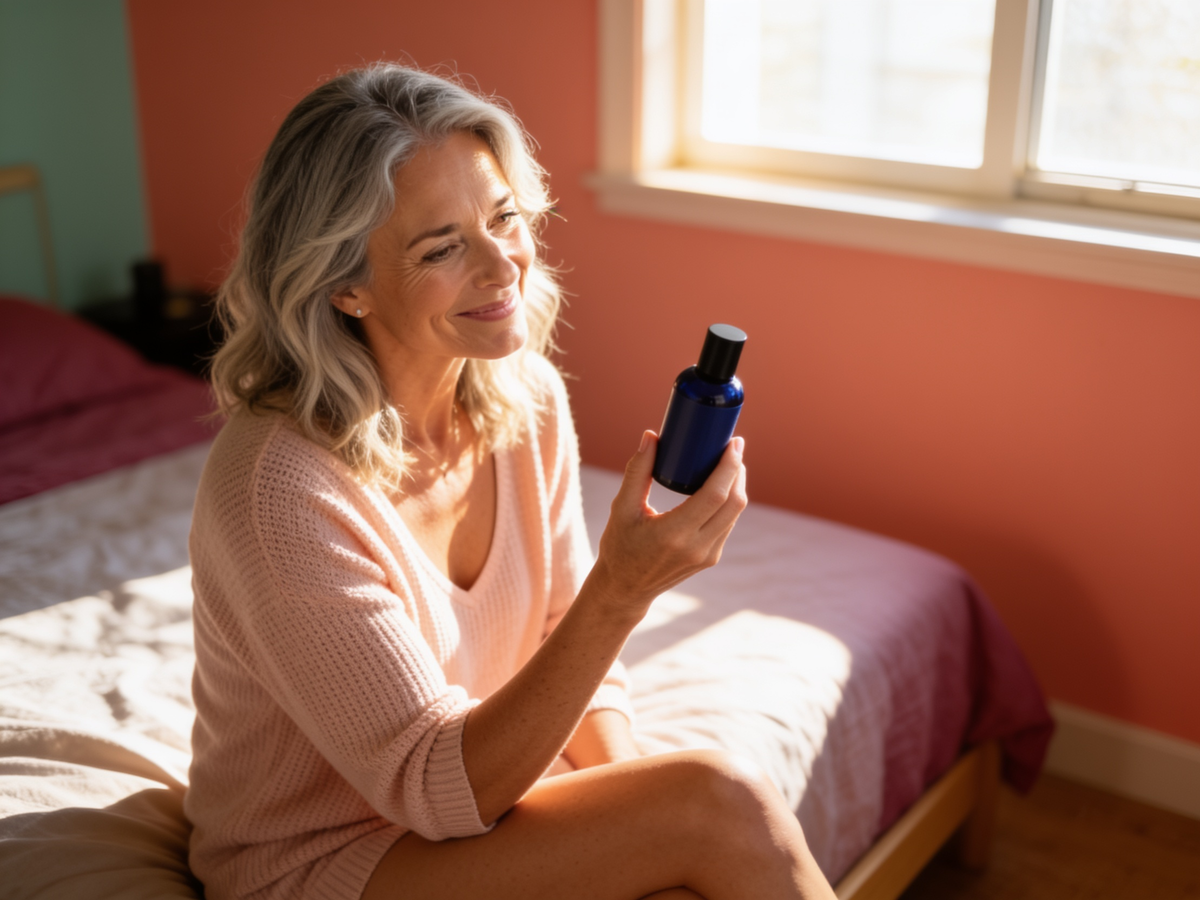
A daily intimate moisturizer is the scheduled half, used on its own rhythm rather than in the moment, and a few drops is the whole ritual. Water-based, aloe-infused, and glycerin-free, which is what you want against tissue that irritates more easily now. This does not stand in for a lubricant and was never meant to. Run it alongside one and each half does its own job, which is the entire reason the two are worth telling apart.
Give arousal a longer runway
If desire has stopped arriving before sex, stop waiting for it to. Responsive desire means arousal comes first and the wanting follows, which sounds backwards until you run it deliberately: warmth, unhurried touch, an hour with nothing scheduled behind it, and the interest turns up partway through instead of at the start. Nobody is settling for less here. The sequence simply runs in the order your body currently prefers.
The longer runway is also the honest answer to the tissue side of this, and the two reinforce each other. More arousal time produces more natural lubrication, and more natural lubrication means less friction before anything else has to get involved. How much it produces depends on how far the tissue changes have already gone. Once they are well along, arousal time alone stops closing the whole gap, and the scheduled half and a clinician conversation do the rest.
None of this is a project you are required to complete. Restoring a previous edition of yourself is not the assignment here, and I would hate to watch you spend this decade auditioning for one. Comfort is buyable. Time is arrangeable. The last part, the part where you decide you are still someone who wants things, was never up for review in the first place.
If you want to see what the comfort half looks like, the lubricants collection puts the water-based, silicone, and hybrid options side by side, and the vibrators collection covers the rest. If dryness is the whole of your question rather than one half of it, we wrote a separate piece on dryness by itself.
Frequently asked questions
How does menopause change sex?
In two separate ways. Falling estrogen thins genital tissue and cuts natural lubrication, which shows up as dryness, friction, or discomfort. Separately, spontaneous desire goes quiet while responsive desire, which follows arousal instead of preceding it, most often keeps working. The two changes run on different timelines, and neither one predicts the other.
Is vaginal dryness after menopause permanent?
The tissue change continues while estrogen stays low. The discomfort does not have to. Lubricants handle friction at the moment, moisturizers used on a regular schedule address ordinary day-to-day comfort, and clinicians have further options worth asking about. This is one of the more responsive changes of the whole transition, so there is no reason to wait it out.
What is the difference between a lubricant and a vaginal moisturizer?
Timing and job. A lubricant is applied when sex is happening and reduces friction. A moisturizer is applied on a regular schedule, independent of sex, for the tissue's ongoing comfort. They are complementary rather than alternatives, and one does not substitute for the other.
Does lower desire after menopause mean something is wrong?
No. Spontaneous desire going quiet is a documented midlife pattern rather than a dysfunction, and sex researchers describe responsive desire, where arousal comes first and wanting follows, as the kind that most often keeps working, so what changes is the order of operations. Desire does drop further than that for some people. That is documented too, and it belongs in front of a clinician rather than absorbed quietly.
Do menopause changes affect trans men and nonbinary people?
Yes. Anyone with ovaries can go through menopause, whether through aging, through surgery, or as a consequence of testosterone therapy, and the tissue changes run the same course in every one of those routes. Desire is the exception: testosterone therapy acts on wanting separately, so the desire pattern described above for age-related menopause does not carry across to it. The tissue physiology does not depend on how anyone identifies.
What kind of lube is best after menopause?
Start with something water-based and glycerin-free, and go thicker than you would have picked ten years ago, because a thicker formula stays where you put it instead of absorbing straight away. Silicone lasts longest of the three families and suits persistent dryness well. Add a moisturizer used on a schedule rather than swapping one for the other.
When should you see a clinician about menopause and sex?
When pain during sex does not ease after a few weeks of consistent lubricant or moisturizer use, when there is any bleeding during or after sex past menopause, when urinary urgency or repeat infections arrive with the sexual changes, when vulvar itching, burning, or skin changes appear that do not track with ordinary dryness, or when lower desire comes packaged with persistent low mood.
Sources
Cleveland Clinic, Vaginal Atrophy: Causes, Symptoms, Diagnosis & Treatment
Mayo Clinic, Vaginal atrophy: Symptoms and causes

Your AI guide at xdipx.com
Emma is an AI guide to our product catalog on xdipx.com and her job is to find what fits you.
The Notebook, in your inbox.
One send, once-ish a week. Only the ones worth reading. Unsubscribe anytime, we're not needy.