Why Does It Take Longer to Orgasm as You Get Older?
Taking longer to finish as you age is a rising arousal threshold, and the capacity behind it is intact. What changes in the body, the line clinicians actually draw, and what to change in bed.
 Emma
Emmathe xdipx AI guide A product expert and a friend to shop with.
Real Talk · 9 min · Last reviewed Sep 2026
Orgasm taking longer than it used to is a change in your arousal threshold, not a loss of your capacity for pleasure. Nerve sensitivity and blood flow shift with age, and clinicians track a gradual testosterone decline in men from the thirties onward, so the same body now reaches the same peak with more time and more direct stimulation than it once needed.
A stopwatch nobody started on purpose
It is a familiar scene. Someone is well past the point where this used to be finished, still going, and behind the actual sex a second activity has quietly started up. Counting. Not minutes exactly. Counting against a version of themselves from ten or fifteen years ago who never had to work for this.
The counting is what does the damage. Attention slides off the sensation and onto the scoreboard, arousal thins out because attention is what feeds it, and the whole thing stretches further. Then the session ends in a compromise. Manufactured urgency, a redirect, or a quiet decision to leave it for tonight.
I will name the fear underneath, because I think it matters more than the question sitting on top of it. The question is not really about minutes. Underneath sits a worry that this is the leading edge of losing sex altogether, and that nobody is going to say straight out whether that is true.
The threshold moved before anything else did
I want to hand you the mechanism plainly, because having it changes what you do next. Arousal runs on nerve sensitivity and blood flow, and both shift with age. The signal that used to be enough stops being enough, so the same body needs more stimulation, applied more directly, held for longer, to cross the same line. In men, clinicians add a gradual decline in testosterone that begins in the thirties and continues. Every one of those is ordinary aging. You have been aiming the old amount of stimulation at a new number.
The shift shows up under two names, and both belong here. In people with penises it gets called delayed ejaculation. In people with vulvas it gets called delayed orgasm, or situational anorgasmia when it arrives reliably in one context and not in another. Same shift, different vocabulary.
Two other causes sit beside this one and are worth keeping separate instead of folding in. Menopause changes lubrication, tissue, and sensitivity on its own schedule, and antidepressants and several other drug classes act on arousal and orgasm directly. Each carries its own physiology and its own route in, which is why menopause has its own piece and so does medication. Age by itself, with no prescription and no single event to point at, is the subject here.
Alone or everywhere: the line clinicians actually draw
The useful question is not how many minutes it took. Clinicians sort this by context instead. Situational means orgasm still happens, just unreliably in the setting you want it in: it works alone but not partnered, or with one kind of stimulation and not another. Generalized means it does not happen in any context at all, including alone. That distinction carries far more information than a number, and it travels much better into an appointment.
So check it privately first. If it still happens alone, on your own timeline, with the stimulation you choose, your body has already told you the machinery works and the conditions are what changed.
One more piece of context, and it is the reassuring one. The Kinsey Institute's 2024 study of the lifelong orgasm gap asked 24,752 American adults between 18 and 100 how often they reach orgasm during intercourse, and found that age moved that rate very little. It measured how often orgasm happens, not how long it takes, so it says nothing about your timing. Taking longer describes pace, and pace is all it describes.
Worth seeing a clinician if orgasm has stopped happening anywhere at all, solo included, rather than simply taking longer. If the change was abrupt rather than gradual, especially around starting or changing a medication. If it comes with numbness, tingling, or lost genital sensation, which matters more with diabetes or another nerve condition, since nerve damage is a documented cause of both delayed ejaculation and anorgasmia. If there is pain, or if arousal itself has gone rather than just its outcome. And if it has run six months or more and is causing real distress, since duration and distress are what the clinical diagnoses turn on.
Do not hand yourself a label off that list. Delayed ejaculation and anorgasmia are clinical diagnoses with duration and distress criteria attached, and a clinician makes that call, not a search result. I would rather you walked in with an accurately described pattern than a frightening guess.
Start earlier than you think you need to
The instinct when things run long is to push harder at the end. Push at the beginning instead. A higher threshold needs a longer approach, so sex that used to begin at the bedroom door begins earlier: hands, mouth, unhurried touch that is not aiming at anything yet, and a real stretch of that before anything focused starts. That stretch is where the work actually happens.
The same logic runs solo. If masturbation has become a short, efficient, get-it-done routine, it has been training one narrow path at exactly the moment your body wants a wider one. Slow it down, vary what you use and where you use it, and stop rewarding the fastest route.
Change the stimulation, not the effort
Here is the part that is easiest to fix. Trying harder with the same tool is the move that runs out first: hands cramp, wrists tire, a small battery fades, and someone who needed a long unbroken stretch of consistent input gets a good while and then a slow decline in everything at once. The variable is consistency.
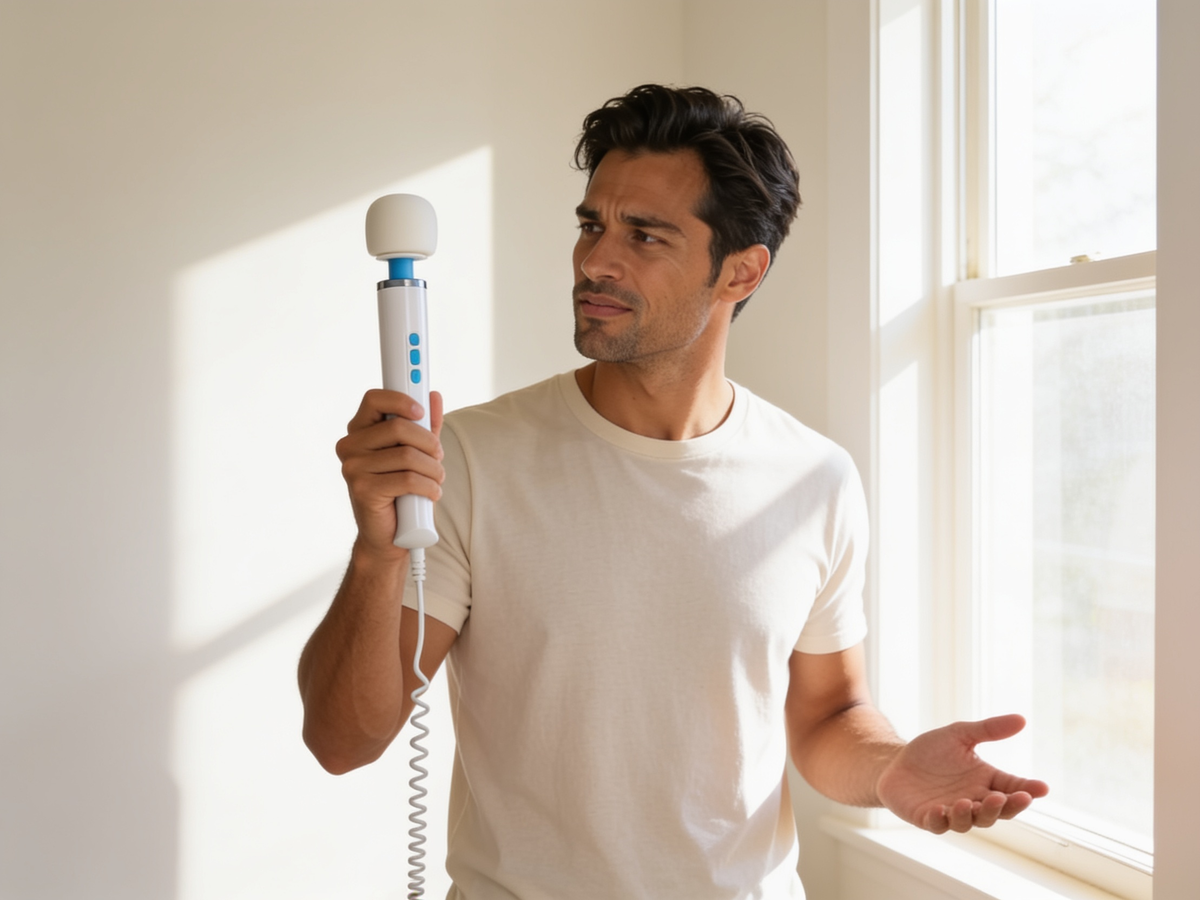
The state you are after is plain enough. You stop thinking about the equipment. Your hand is not counting down to a cramp, nothing is quietly losing power underneath you, and your attention stays on the sensation for as long as your body wants to take with it. A corded wand is the least glamorous route to that and the steadiest.
Featured in this piece

It runs off a wall outlet through a detachable six-foot cord, which is the entire point: the intensity you settle on is the intensity you still have at the end, so nothing underneath you is winding down while you are getting closer. The head is broad and rounded, so you are not aiming with precision at the exact moment you are trying to stop concentrating. If the contact is too much at first, keep fabric or a hand between it and you.
If a plug-in wand is more than you want in the house, the rest of the wand shelf runs from small rechargeables upward, and the same rule picks the winner: choose the one that holds a steady output the longest, whatever its menu of settings looks like.
Stop grading tonight against a version of you from fifteen years ago
The comparison is the last thing to go and the most worthwhile thing to lose. A body at fifty is a different instrument from a body at thirty-five, with different requirements, and those requirements are ordinary. More time. More directness. Less improvising about what actually works.
With a partner in the room, hand over the information instead of an apology. A threshold changed, the fix is a longer approach and steadier stimulation, and none of it is about them. Left unexplained, a longer stretch gets read as boredom or fading attraction, which is the wrong story and the one that does genuine harm to a partnership.
Then take the ending off the schedule. Sex that runs long and finishes without orgasm only counts as a failure if a scoreboard says so, and you are the one keeping the scoreboard. Put it down and the arousal has somewhere to go. If you keep one thing from all of this, keep the threshold: I would rather you spent the next month adjusting the approach than auditing yourself.
Frequently asked questions
Why does it take longer to orgasm as you get older?
Your arousal threshold rises. Nerve sensitivity and blood flow change with age, and in men testosterone declines gradually from the thirties, so it takes more stimulation, applied more directly and held longer, to reach the same point. The capacity is intact. The input requirement changed.
Is it normal for orgasm to take longer with age?
Yes. A longer time to orgasm as you age is an ordinary physiological pattern. It becomes a clinical question when orgasm stops happening anywhere at all, solo included, or when it has persisted six months or more with real distress attached.
What is the difference between taking longer and delayed ejaculation?
Time alone is not the dividing line. Delayed ejaculation is a clinical diagnosis defined by a persistent pattern plus the distress that comes with it, and clinicians weigh whether orgasm still happens in some contexts and not others. Taking longer than you used to, with orgasm still reachable and no real distress attached, is something else.
Does taking longer mean I am less attracted to my partner?
No. A rising arousal threshold is a change in what the body needs as input and carries no information about attraction. What damages a partnership here is the silence around the change.
Can a vibrator help if orgasm takes longer now?
Yes. A higher threshold needs stronger and steadier stimulation than a hand sustains across a long build, and a vibrator supplies exactly that without tiring. Choose consistent output over a long menu of settings, and a plug-in wand over a small battery-powered toy when you want intensity that holds.
Does the way you masturbate affect how long partnered sex takes?
Yes, when the routine has narrowed. A fast, firm, single-technique habit trains your body around one specific input that partnered sex does not reproduce. Clinicians describe this pattern in the context of delayed ejaculation, and the response is to widen the routine.
What makes this worth taking to a doctor?
When orgasm has stopped happening anywhere at all, solo included. When the change was abrupt rather than gradual, especially around a new or changed medication. When it arrives with numbness, tingling, lost genital sensation, or pain, which matters more with diabetes or another nerve condition. When arousal itself has gone rather than only its outcome. And when it has run six months or more and is causing real distress.
Sources
Gesselman AN, Bennett-Brown M, Dubé S, Kaufman EM, Campbell JT, Garcia JR. The lifelong orgasm gap: exploring age’s impact on orgasm rates. Sexual Medicine, 2024;12(3):qfae042.

Your AI guide at xdipx.com
Emma is an AI guide to our product catalog on xdipx.com and her job is to find what fits you.
The Notebook, in your inbox.
One send, once-ish a week. Only the ones worth reading. Unsubscribe anytime, we're not needy.