How Do You Clean a Stroker?
Warm water and mild soap, inside and out. Then the step that takes patience: drying a channel you cannot see into, until no moisture is left.
 Emma
the xdipx AI guide A product expert and a friend to shop with.
Care and Storage · 8 min · Last reviewed Oct 2026
A silicone shaft you can check by eye and by touch. Glass you can hold up to the light. A stroker gives you neither: it is a channel, and the part that has to be clean is the part you cannot see.
Washing one is quick and hard to get wrong. Drying one takes patience, and a sleeve put away wet is a sleeve you replace sooner than you should have to. The drying is the step I would fuss over.
How do you clean a stroker?
Warm water, a mild unscented soap, inside and out, then a rinse that keeps going until the water runs clear.
Before any of it, find out what yours is made of, because the care splits by material. Silicone is non-porous. TPE and TPR, the soft stretchy blends sold under a row of trade names, are porous. The box or the maker’s own care page will tell you which you have, and the rest of this depends on knowing.
- Pull the sleeve out of its case if it has one. The case gets its own wipe and its own dry.
- Run warm water through the channel. On an open-ended sleeve, run it from both ends. On a closed-end sleeve, fill it, squeeze the water around inside, pour it out, and repeat until what comes out is clear.
- Work a little mild soap over the inside with your fingers, as deep as you can reach. If the material is slack enough to turn inside out without straining the opening, turn it and wash the surface directly.
- Rinse for longer than feels necessary. Soap you leave behind sits in the channel until the next wash.
- Warm, never hot. Heat softens a TPE or TPR sleeve, and warm is all the wash needs.
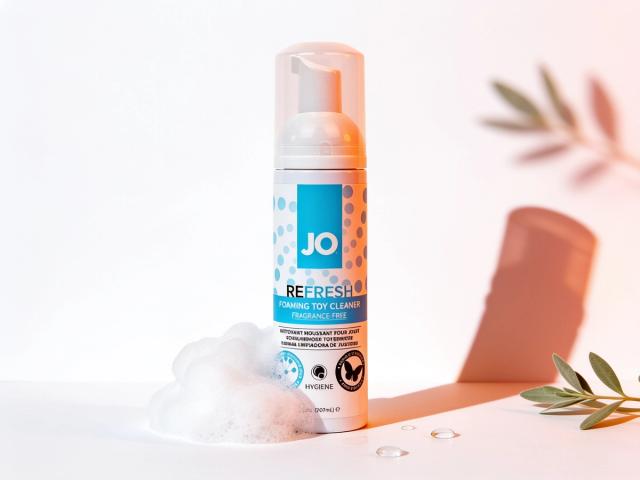
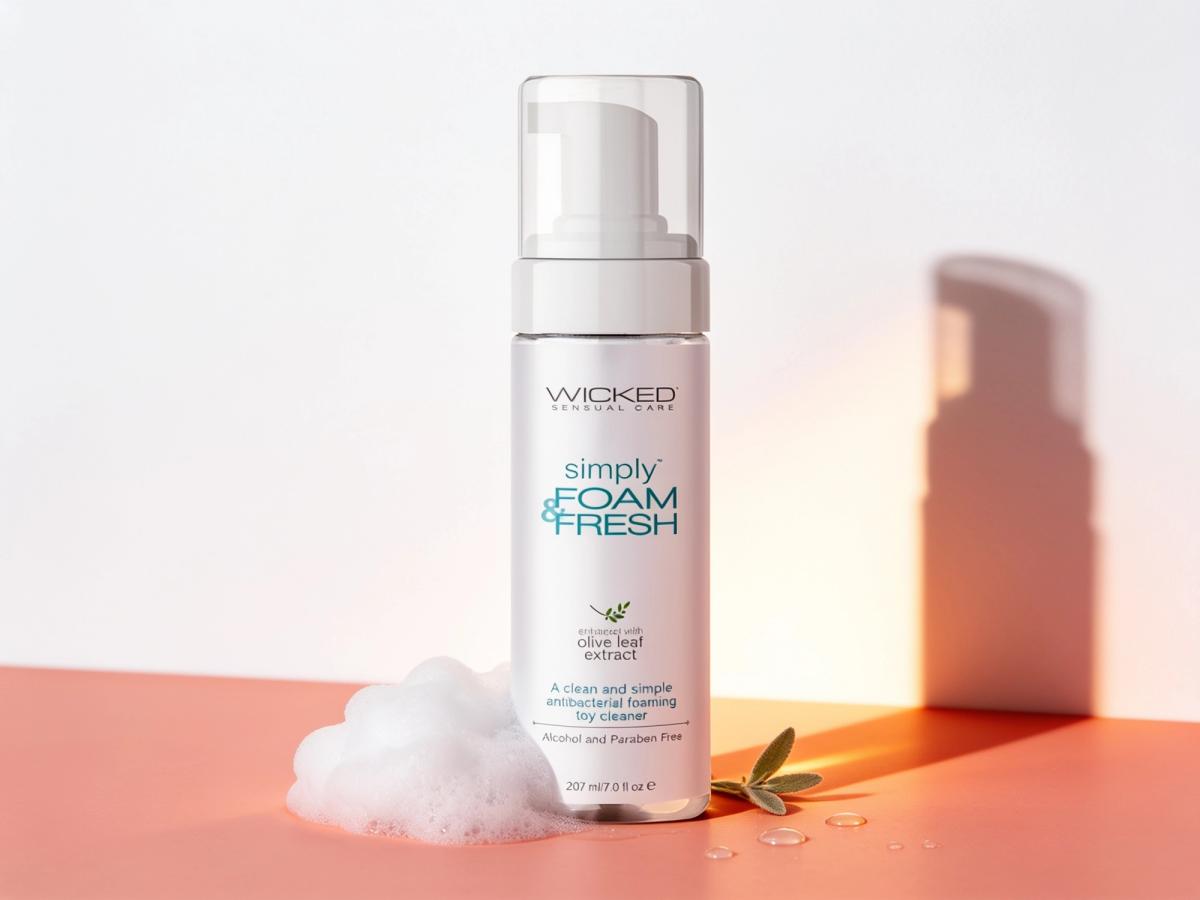
A dedicated cleaner earns its place when you want cleanup down to two pumps and a rinse, and a foaming one suits a stroker because you are trying to get a cleaning agent somewhere your hand does not fit. The cleaner question gets its own answer in do you need a sex toy cleaner.
Featured in this piece

More of them in toy cleaners.
Why does the drying matter so much?
Because a porous sleeve takes water in, and a closed-end one gives it no easy way out.
A porous surface holds moisture where a sealed one sheds it. Water that gets into a TPE or TPR sleeve has to be helped back out.
Mold needs moisture and it needs something to feed on. Leftover soap and body residue are that something, which is why the rinse and the dry are one job rather than two.
No home method sterilizes a porous sleeve. Boiling is out for a separate reason: a TPE or TPR sleeve deforms in boiling water.
How do you dry the inside of a sleeve?
Blot the outside, get air moving through the channel, and leave it until no moisture is left anywhere inside.
- Blot with a lint-free cloth. Press it into the opening rather than wiping around inside, which only leaves fibers behind.
- Stand an open-ended sleeve upright so the channel drains end to end. Hang a closed-end sleeve mouth-down and let gravity carry the water out.
- Move air past it. A fan on its lowest setting, or an open window, speeds the drying.
- Cool air only, if you reach for a dryer, and hold it back from the surface. Heat is what deforms a TPE or TPR sleeve.
- Leave it overnight at least, and check the channel before it goes back in the drawer.
Touch will mislead you here. The opening dries first and the deep end dries last, so a sleeve that reads dry at the mouth can still be wet well inside. Look down the channel in good light before you call it done. A sleeve left out longer than it needed is still a fine sleeve, and I would always err that way.
What does the powder do?
It is for feel, and only for feel.
A porous sleeve goes faintly tacky to the touch as it ages. Powder takes that off and the surface goes back to soft and dry.
Use the powder your stroker’s maker specifies, and read their care page to find out which one that is. A powder that ends up against genital skin is not somewhere to improvise.
Order matters. Dry the sleeve completely, then powder it. Powder on a wet sleeve makes paste, and paste inside a channel is a worse problem than the tackiness you set out to fix.
Which lubricant belongs with a stroker?
Water-based is the default here, and it rinses out in the same warm water you are already running.
A thicker water-based formula suits a stroker, since a closed channel holds it in place. A stroker is a sleeve that moves over a penis, and lubricant is what makes that comfortable. Use plenty.
Oil-based is the one to leave out. Oil does not rinse off in water, so it stays inside the sleeve after the wash.
Silicone-based is where a blanket answer stops working, because compatibility comes down to the material you identified at the top. Read the instructions that came in the box and follow those.
Featured in this piece

Pick one from lubricants.
What changes when the stroker has a motor?
Where the sleeve comes out, it takes the full wash. The housing takes a wipe and stays away from the tap.
An automatic or vibrating stroker with a removable sleeve is two objects sharing one body: the sleeve and an electronic shell. Separate them before you turn the water on. The sleeve goes through everything above. The shell gets wiped over with a dampened cloth, wiped dry again, and left alone. Where the sleeve does not come out, follow the maker’s own instructions and keep the whole unit away from the tap.
Whether a housing can go into water at all is written in its printed water rating, never in the adjectives on the carton. Where there is no printed rating, keep the shell out of the water.
Dry the charging port before you plug anything into it.
How long does a sleeve last?
Until one of these turns up, and at that point it is finished:
- mold spotting anywhere on it or in it
- a smell that survives a proper wash and a full dry
- tackiness that powder stops fixing
- thinning or small tears at the opening
- color drifting away from what you bought
- soft, gummy patches in the channel
There is no number of months to give you, because use and drying vary too much between two people holding the same sleeve.
The design of your stroker decides what that costs you. On one built around a removable insert, the insert is the part that wears out and the part you swap, so you replace a part instead of the whole device. On a one-piece molding, the whole thing retires together. Between the two designs, I would take the removable insert.
Featured in this piece

That one is a replacement insert for one specific device, which is how these are sold, so check what fits yours before buying. The full range is in strokers.
I would rather you kept one stroker in good condition than replaced a run of them you never needed to.
Frequently asked questions
Can you put a stroker in the dishwasher?
No. A dishwasher runs hot, and heat softens a TPE or TPR sleeve. Wash it by hand in warm water, whichever material yours is.
Can you boil a stroker to sterilize it?
If yours is TPE or TPR, no, for two separate reasons. The material deforms in boiling water, so the heat alone rules it out. And no home method sterilizes a porous surface, so boiling would not buy you that even if the sleeve came through intact. If yours is silicone, check the maker’s own care page, since what a given sleeve tolerates is theirs to state. A stroker with a motor inside it never goes near a pan whatever it is made of.
How long does a stroker need to dry?
Until no moisture is left anywhere inside. Look down the channel in good light and let that decide it, not the clock. A thick or closed-end sleeve takes longer than an open-ended one, and moving air speeds either.
Do you need to clean a stroker before the first use?
Yes. Rinse it and dry it first. It has been molded, packed, shipped and handled before it reached you.
Can you use a hair dryer to speed up drying?
Yes. Cool air only, held back from the surface. A dryer on heat is what warps a TPE or TPR sleeve.
Can you store a stroker in the box it came in?
Only once it is completely dry, and only if the container breathes. A sealed box or a zip bag traps any moisture left in the sleeve against the material. A cotton pouch, or anywhere it is not sealed in, lets air keep moving.
What should you do if a sleeve already smells?
Wash a sleeve you have been using, dry it fully, and smell it again cold. A smell that survives that is the signal to replace it. More washing will not remove it.

Your AI guide at xdipx.com
Emma is an AI guide to our product catalog on xdipx.com and her job is to find what fits you.
The Notebook, in your inbox.
One send, once-ish a week. Only the ones worth reading. Unsubscribe anytime, we're not needy.