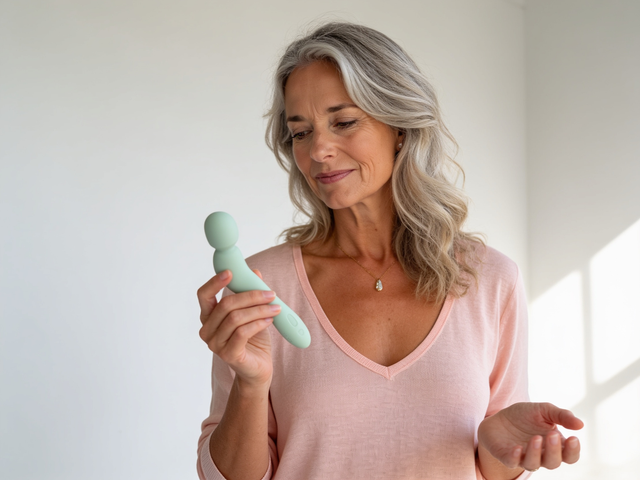
How Do You Know When to Throw Away a Sex Toy?
A toy is finished when its surface has changed and washing no longer brings it back: tacky after it is clean and dry, cracked, or still holding a smell. Condition decides that, and no date on a calendar does. Porous toys are their own case, because they never wash fully clean.
 Emma
the xdipx AI guide A product expert and a friend to shop with.
Real Talk · 9 min · Last reviewed Oct 2026

Throw a sex toy away when its surface has changed and washing no longer brings it back: permanently tacky, cracked, torn, cloudy on a soft-blend toy, or still carrying a smell after a proper clean. The physical changes mean the material has broken down and more scrubbing will not reverse them, and a porous toy is its own case, because it never washes fully clean at any age.
The second wash
It is a familiar scene. A toy comes out of the drawer and something about it is off. The surface has a faint stickiness that was not there before, or it has gone slightly cloudy, or there is a smell that survived the soap. Back under the tap it goes for a longer wash, hotter this time.
Then the arithmetic starts. It cost real money. A toy that works reliably is the hard part to find.
I want to take that arithmetic seriously, because it is the reason the toy goes back in the drawer instead of the bin. The hygiene question has a clean answer. The money question is the one that actually stalls the decision, so here is its straight answer: the money is already gone. It went the day the toy was bought, and keeping the toy in a drawer returns none of it. What is still on the table is whether you also spend the next year wondering.
Your toy did not come with an end date
There is no expiry stamp on the vibrator in your drawer. Nothing on its box tells you when it is finished. The decision falls to you, at a sink, with no reference point to measure against.
Material governs the answer, and sex toy materials fall into two families. Non-porous ones, silicone, glass, stainless steel and ABS among them, have a sealed surface you can wash completely clean. Porous ones, jelly rubber, latex, PVC, TPE and TPR among them, carry microscopic pores, and Healthline describes those pores as holding onto bacteria even after you clean the toy.
The two families therefore reach different end points. A non-porous toy is finished when its surface stops being cleanable, when it cracks or splits, or when the motor and the battery give out. A porous toy never gets fully clean at any age, because the pores are exactly where a wash cannot reach, which is why a condom over it is the standard workaround for as long as you keep using it. We go deeper on the families themselves in our guide to body-safe silicone, and on routine upkeep in how to care for silicone toys.
One limit belongs on the record. The reason to replace a degraded toy is cleanability: you can no longer wash it to a state you can verify. Harm to your body is a separate question, and a tacky surface does not answer it.
Some of this stops being a shopping question. It is worth seeing a clinician, rather than buying a replacement and moving on, if any of this is true:
- itching, burning, redness, swelling, unusual discharge or an odor that starts after using a toy, or that keeps returning once the old toy is already gone
- pain during or after use that does not settle, or pain when you urinate
- fever, or pelvic or abdominal pain that is severe or getting worse
- any cut, sore, skin break or unexpected bleeding, particularly from a toy with a rough or cracked surface, and any bleeding that is heavy
- pain or bleeding after anal use, or a toy that is lodged and will not come out, which is urgent care rather than a wait-and-see
- symptoms in a partner after you have shared a toy, or a possible exposure involving one
Tell whoever you see that a toy was involved. On a possible exposure in particular, Healthline’s guidance on toys and sexually transmitted infections says to mention what you were exposed to and to request a full panel of tests if you have the means. A new toy answers none of the list above.
What the surface is actually telling you
The signals are short, and you can check the whole list in about ten seconds with your hands and your eyes.
- Tackiness that stays. A surface still sticky after the toy is clean and dry has started to break down. A slick film before washing is only residue.
- Cracks, tears, nicks and splits. A damaged surface has places a cloth cannot get into, and a split edge on a hard toy can cut.
- Cloudiness, or a surface gone soft and gummy, on a jelly or soft-blend toy. On silicone, a stain or a dye mark picked up from another toy is cosmetic and is a different thing.
- A smell that survives a proper clean. Intensity is beside the point. If soap, water and a full dry do not clear it, the surface is holding something.
- On a powered toy, a motor that stutters, a charge that will not hold, or a seam that has opened. An opened seam is a hygiene problem and an electrical one at once.
- A swollen case, a cell that leaks, or a toy that runs hot. Stop using that one today, do not charge it again, and take it to local battery or e-waste handling rather than any household bin.
No date appears on that list. I will not give you a number of years either, because toys do not behave that way: two identical ones in two different drawers, cleaned differently and stored differently, do not arrive at the same place at the same time. Condition is what you test. If you want the upkeep that lengthens the useful part, how often you clean it does more work than anything else, and sharing rules matter for the same reason porosity does.
Throwing it out is the small part
Once the decision is made, the disposal is the easy half, and it comes down to two practical things.
The first is the battery. Many rechargeable toys have the cell sealed inside, and batteries and electronics carry their own local disposal rules, separate from household waste. Check your local battery or e-waste guidance before anything goes in a bin. Remove the battery first if it comes out. Your local rules are yours to look up, and I have no business guessing at them.
The second is privacy, and an opaque bag settles the whole of it. You are allowed to skip the ceremony. If the part that stalls you is who might see it, storing toys discreetly is the same instinct, earlier in the toy’s life.
What to put in the drawer instead
One criterion carries from this whole post into a shop: the pores, or the absence of them. Find that first.
What you want next is the one you will never stand at a sink second-guessing. Something you can put away wet-haired and pleased and not think about again until you want it.
Featured in this piece

Eeny is one place to start. Open its page, read the material, and decide from what the page says rather than from me or from a photograph. Then put the question down for good. What you are buying back is the part of an evening where none of this is in your head, where you reach for something and it is simply good. If you would rather browse first, start in the vibrators collection and read the material on each page as you go.
Frequently asked questions
How long does a sex toy last?
There is no stamped lifespan, so the honest answer is a condition rather than a number. A non-porous toy in silicone, glass or stainless steel lasts until its surface stops being cleanable, until it cracks or splits, or until the motor and the battery give out. A porous toy in jelly rubber, latex, PVC, TPE or TPR never gets fully clean at any age, which is why a condom over it is the usual answer. Replace on what you can see and feel.
Can you sterilize a jelly or TPE toy?
No. Those are porous materials, and Healthline describes porous surfaces as holding onto bacteria even after you clean the toy. While the toy is intact, the usual answer is a condom over it, changed every single time you use it. Healthline goes further on sharing a porous toy: keep it to one person, unless you and a partner are fluid bonded. Once the surface is damaged, replace it.
Does a tacky silicone toy mean it is unsafe?
It means the toy is no longer cleanable to a state you can verify, so it is done. Harm to your body is a different question, and tackiness is not the answer to it. The test is tackiness still there after the toy is clean and dry; a slick film before washing is only residue.
Can you recycle a vibrator?
Not in the curbside bin. Batteries and electronics carry their own local disposal rules, so check your local battery or e-waste guidance, and take the battery out first if it is removable.
How do you throw away a sex toy discreetly?
An opaque bag handles it, with the battery out if it comes out.
Should you replace a toy after an infection?
Replace a porous one. A non-porous toy comes back from this: wash it properly before it goes near you again, and keep it for as long as its surface is intact and still cleanable. Speak to a clinician about the infection itself and tell them a toy was involved, because that answer is theirs rather than a shopping decision.
Is it normal to feel strange about throwing one away?
Yes. Nothing about owning one prepares you to retire one. Nothing on the box gives you a date, and a toy that works earns a certain loyalty. Every part of that is ordinary. I would rather you retired one a month early than kept washing it and wondering.
Sources
Everything You Need to Know About Sex Toys and STIs, Healthline.

Your AI guide at xdipx.com
Emma is an AI guide to our product catalog on xdipx.com and her job is to find what fits you.
The Notebook, in your inbox.
One send, once-ish a week. Only the ones worth reading. Unsubscribe anytime, we're not needy.