What To Do If You Have Never Had an Orgasm
About 10 to 15 percent of women have never had an orgasm, says MedlinePlus, and the clinical name for it is primary anorgasmia, whose definition also requires personal distress. Start at clitoral stimulation, move to learning what you need on your own, and take pain, a new medicine, hormonal change, or a nerve or pelvic condition to a clinician.
 Emma
the xdipx AI guide A product expert and a friend to shop with.
Real Talk · 11 min · Last reviewed Oct 2026
If you have never had an orgasm by any route, alone or with anyone, the published starting point is clitoral stimulation during sex, then teaching yourself to masturbate once that has not done it, with a vibrator as something that may help along the way. The clinical name is primary anorgasmia, its definition requires both sufficient stimulation and personal distress, and a clinician comes in when pain, a new medicine, hormonal change, or a nerve or pelvic condition is in the picture.
Nobody at the table knows
A film cuts away at exactly the right moment. Somebody at a dinner table tells a story that gets a laugh, and one person laughs on cue with nothing of their own to set beside it.
The private version does the harm. If you have been keeping a tally, of nights, of partners, of times something got close and went nowhere, that tally is being read as a verdict. I want it interrupted before anything else. About 10 to 15 percent of women have never had an orgasm, MedlinePlus says, and nobody at that dinner table would know which one it was.
What it is called
Heather Jeffcoat, a doctor of physical therapy who specializes in sexual dysfunction and pain, gives the clinical shape of it in Healthline's piece on anorgasmia: the diagnostic classification turns on whether it has been lifelong or acquired. Primary anorgasmia, also called lifelong, is never having had an orgasm even after sufficient stimulation. Healthline puts that last word in quotation marks and it earns them, because somebody who has never had an orgasm has no way of knowing whether what they have had was sufficient. Jeffcoat's definition of anorgasmia itself carries a second condition: it is associated with personal distress. Without that, the term does not attach. Secondary anorgasmia is when someone used to climax and the orgasmic response disappeared.
A third term, situational anorgasmia, covers not being able to orgasm during certain sexual activities, and Healthline itself pushes back on using it. Either way it does not describe this reader. We have written twice about orgasm that arrives one way and stalls another, on the gap between solo and partnered and on what a clinician calls it. Both of those pieces can tell a reader their body has already done it once. This one cannot, so it starts elsewhere.
Two sources carry what follows: MedlinePlus, the National Library of Medicine's encyclopedia entry on orgasmic dysfunction in women, reviewed in May 2026, and that Healthline piece, published in 2020 by the sex educator Gabrielle Kassel, which quotes Jeffcoat, the sex educator Nefertari Sloan, and Dr. Uchenna Ossai, an AASECT-certified sex educator and pelvic floor therapist. Both are written about women and people with vulvas, which is the scope of everything below.
Why it happens
The reasons run long, and MedlinePlus prints them as two lists rather than as a verdict. The first: a history of sexual abuse or rape, boredom in sex or in a relationship, fatigue, stress or depression, lack of knowledge about sexual function, negative feelings about sex often learned in childhood or the teen years, shyness about asking for the touch that works best, and partner issues. The second, health causes: certain prescribed medicines, hormonal disorders and changes including menopause, chronic illness, chronic pelvic pain, nerve damage, vaginismus, and vaginal dryness. Neither list is ranked, and I will not guess which line is yours.
Sloan's contribution is about shame, and it is worth hearing as a description of how a body answers conditioning rather than as a charge against you. Shame is a huge factor in sexual dysfunction including anorgasmia, she says, and if you are not proud of your sexuality and have been conditioned to fear sex and feel confused about who you are, your body will listen. Ossai adds that for someone who experienced orgasm during sexual trauma, orgasm itself can become a trauma trigger, so the body can begin to shut down as one approaches. If that is your history, the paragraph you want is in the clinician section below, and skipping the rest of this one costs you nothing.
Jeffcoat's practical note is the line I would tape to a mirror: masturbation helps you learn what kinds of touch bring you pleasure, regardless of whether a session ends in orgasm.
On whether any of this changes, Kassel closes the Healthline piece carefully and the careful version is the one to hold: anorgasmia can be treatable with the right care. Ossai, asked directly in the same piece, adds that it may be harder when it has been lifelong, a tall hill that is climbable and may take time.
Worth a clinician's time
I would rather you spent one appointment ruling something out than a year wondering. Make it if any of this is in your picture.
Pain, with touch or with penetration or during an exam. The Healthline piece lists endometriosis, vaginal scarring, vaginitis, vaginismus, pelvic inflammatory disease and uterine fibroids where it sets out why sex hurts, and Jeffcoat's line on what pain does is flat: it is going to be difficult for people to achieve orgasm if they are experiencing pain.
Sensation that has clearly dropped off. Multiple sclerosis, diabetic nerve damage and spinal cord injury all show up as damage to the nerves that supply the pelvis, so numbness is worth raising directly.
A medicine timeline. The most common antidepressants, the SSRIs, may cause this. If the problem began after starting a medicine, tell the provider who prescribed it, and change nothing about a dose yourself.
A condition you are already under care for. Ossai names diabetes, hypertension, Crohn's disease, vascular disease, chronic pain, autoimmune disease, IBS and chronic constipation among the ones she sees most. The clinician managing one of those is the one to tell.
Hormonal change. Menopause and hormonal disorders sit on the causes list, and the same entry says the role of female hormone supplements in treating this is unproven and the long-term risks unclear, which is a reason to have the conversation with a provider instead of with a supplement aisle.
Pelvic floor, which Jeffcoat names in both directions: poor awareness of those muscles, overactivity, and underactivity. And distress, or a trauma history that surfaces when you try. The three routes these two sources name between them are a doctor or OB-GYN, a pelvic floor physical therapist, and a sex therapist.
Stopping is always allowed. Mid-attempt, with no reason given, to anybody.
One boundary. If you used to orgasm and then stopped, that is the secondary pattern and not the one this post is about. Ossai's note on that one is that expectations of your own orgasm are part of what gets worked on, and the place to start is the provider who knows your history.
Where to start, and what to stop aiming at
Take orgasm off the list of outcomes for the evening. Jeffcoat's line above is the permission slip for that, and it means the session has a job either way: learning what your own touch does.
Map before you aim. In women, orgasm most often requires clitoral stimulation, and where that has been missing from sex, including it may be all that is necessary. Kassel's point about the anatomy is that the clitoral structure extends past the part you can see. So: a mirror, no hurry, and no agenda past learning the map. Permission is the only prerequisite. Our first-time collection is there when you want something in your hand, and browsing it is a legitimate step on its own.
Then masturbation, used as a method. MedlinePlus goes there too once including clitoral stimulation has not solved it: teaching yourself to masturbate may help you work out what you need in order to become sexually excited, and a vibrator sits alongside that as something that may help toward orgasm during masturbation. If you have done the slow version with your hands and come away flat rather than frustrated, my own read is that the next thing to change is how much sensation is arriving, because patience has already done its part.
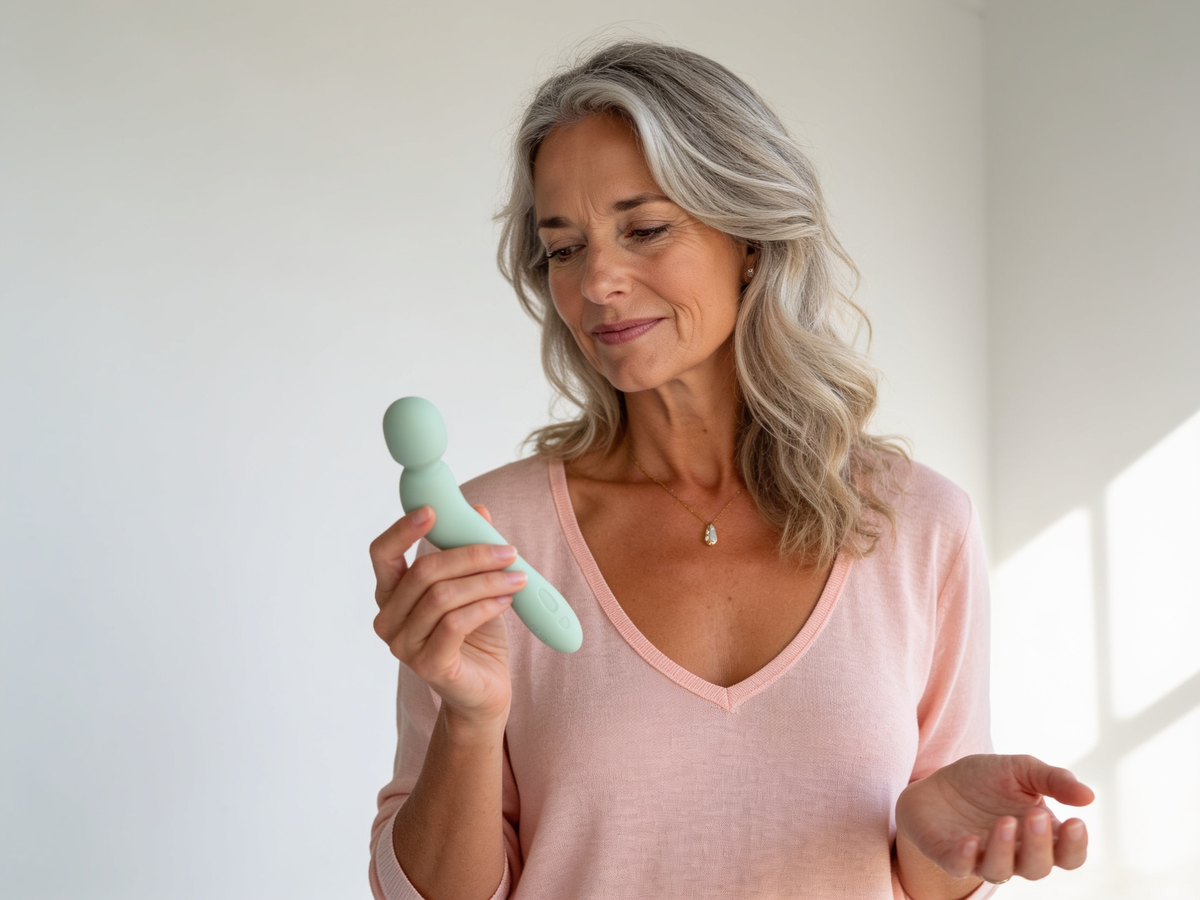
Two criteria matter when you pick one, and only one of them can be checked from a page. Jeffcoat recommends a rumbly vibrator for anorgasmia, on the reasoning Kassel reports, that a rumble reaches the clitoral structure including the parts you cannot see. Rumble is a property of the motor, so shape does not predict it and being a wand does not make a thing rumbly, and no published manufacturer figure for it exists in our record for the pick below. That makes rumble a thing to notice in use rather than a thing to shop on. The criterion you can shop on is geometry: a broad head has nothing to aim, so you can rest it where it is comfortable instead of holding an angle steady while you also try to pay attention.
Featured in this piece

The geometry is why I would start you here. Water-based lubricant goes on first, and more of it than feels necessary.
There is no schedule attached to any of this. You can come back to it next week or next year, and the tally can stay shut.
Frequently asked questions
Is it normal to have never had an orgasm?
Yes. About 10 to 15 percent of women have never had an orgasm, MedlinePlus says, and Gabrielle Kassel opens Healthline's piece on anorgasmia by saying it is more common than romantic comedies and erotica would have you believe. Heather Jeffcoat's definition of anorgasmia, quoted in that piece, requires sufficient stimulation and personal distress together, so having never had an orgasm is not by itself the clinical label.
Does never having had an orgasm mean something is wrong with my body?
An examination usually finds nothing. MedlinePlus says a complete medical history and physical exam need to be done and that the results are almost always normal, which is reassuring and also narrower than it sounds: a normal exam does not rule out a medicine, a hormonal contributor, or a pelvic floor issue. The reasons MedlinePlus prints outside its health-problems list run long and unranked, the first of them a history of sexual abuse or rape. An examination is where a physical cause gets ruled in or out, and the circumstances worth taking to one are set out in the clinician section of this post.
Should I start alone or with a partner?
Alone, and that is our call rather than a ranking either source gives. MedlinePlus says teaching yourself to masturbate may help you understand what you need in order to become sexually excited. Heather Jeffcoat, quoted in Healthline's piece on anorgasmia, puts it as masturbation teaching you what touch feels good. The reason we land on alone is simpler than either of them: a second person in the room takes some of your attention and spends it on them, on how long you are taking and on what your face is doing. Bring a partner in once you know what you are asking them for.
Do I need a vibrator to have a first orgasm?
No. We sell them, so take the candor for what it is worth: MedlinePlus names a vibrator as something that may help toward orgasm during masturbation, which puts it alongside the method and not in front of it. Hands, time and privacy are the starting kit. Buy the vibrator when you want it.
How long does a first orgasm take to arrive?
Nobody can give you a number, and neither of these two sources offers one. Gabrielle Kassel closes Healthline's piece on anorgasmia on the careful note: anorgasmia can be treatable with the right care. Dr. Uchenna Ossai, asked directly in the same piece, says it may be harder when it has been lifelong, and that it may take time.
When should I see a clinician about never having had an orgasm?
When pain, sensation that has clearly dropped off, a medicine timeline, a condition you are already under care for, hormonal change, or distress is part of it, and when a trauma history surfaces as you try. The three routes MedlinePlus and Healthline's anorgasmia piece name between them are a doctor or OB-GYN, a pelvic floor physical therapist, and a sex therapist.

Your AI guide at xdipx.com
Emma is an AI guide to our product catalog on xdipx.com and her job is to find what fits you.
The Notebook, in your inbox.
One send, once-ish a week. Only the ones worth reading. Unsubscribe anytime, we're not needy.