Why Do I Feel Sad After Sex?
Postcoital dysphoria is the name for it, and nobody has established a cause. In the 2015 survey of 195 heterosexual Australian university women, the attachment measures the researchers took did not predict who experienced it. What you can shape is the stretch right after, and that is what aftercare is for.
 Emma
the xdipx AI guide A product expert and a friend to shop with.
Real Talk · 13 min · Last reviewed Oct 2026
Sadness or tearfulness right after sex has a name in the research, postcoital dysphoria. In a 2015 survey of 195 heterosexual Australian university women, 46.2 percent reported inexplicable tearfulness or sadness after consensual intercourse as a problem at least a few times in their lives, and the paper's authors wrote that the causes remain unknown.
When the search for a reason comes up empty
It is a familiar scene, and a hard one to say out loud. The sex was wanted. It was good. Ten minutes later somebody is turned toward the wall with wet eyes and no idea why, or lying still in a quiet that has gone from warm to hollow, running back through the last hour looking for the thing that set it off.
Often there is nothing to name. The search turns to the sex first: was it bad, did I not want it after all. Then to the person beside you: do I not love them. When both come up empty, the emptiness itself starts to look like evidence of something worse.
I want to interrupt that before any explanation starts. The 2015 survey's own item called the sadness inexplicable, which describes what the women answering it could not account for. It does not establish that no cause exists, and it does not mean yours has none. We have written about the other half of this in a different setting, in our piece about a partner who takes a vibrator personally: the person lying beside you may be running a search of their own and reading a turned back as a verdict on them.
It has a name and no established cause
Postcoital dysphoria is the term used in the research and clinical literature. Postcoital tristesse is a synonym, and Medical News Today treats the two as the same thing. Schweitzer, O'Brien and Burri published the prevalence study in Sexual Medicine in 2015, and it is where the 46 percent figure comes from.
Here is what it measured. A convenience sample of female Australian university students, over 18 and sexually active, surveyed online. Of 300 who began, 231 finished, and the analyses ran on 195 of those after the authors excluded bisexual and homosexual participants, citing earlier findings of different patterns in same-sex relationships. The item asked whether inexplicable tearfulness or sadness following consensual sexual intercourse had been a problem, lifetime and in the past four weeks, on a scale from almost never to almost always. Intercourse, self-reported, and the word inexplicable doing real work in the question.
Lifetime, 46.2 percent of those 195 answered above almost-never. For the past four weeks it was 5.1 percent. At the frequent end, 1.5 percent said most times and 0.5 percent said almost always or always, which the paper's own text rounds to about 2 percent. So close to half had felt it at least a few times, and about one in fifty reported it at most-times or always frequency. If you are in the first group, you are in a very large room with the lights off. The authors' limitations matter as much as the number here, and I would read them first: no validated instrument existed for what they were measuring, so they say the prevalence rates need to be treated with caution, the sample was mostly Caucasian and heterosexual, and every report was retrospective.
On cause the paper is blunt. The underlying causes remain unknown, it says, and it offers only the speculation that the etiology is multifactorial. Nobody has pinned this down, and anyone telling you it is simply a hormone crash is ahead of the evidence. Healthline's piece on it quotes four clinicians, and its causes section opens with a sex therapist saying outright that we do not know what causes it and there has not been enough solid research.
The theories on offer there come with their authors attached. The sex therapist names a physiological drop from peak arousal back to baseline, and unconscious guilt about sex. The psychiatrist names past trauma. Body-image shame and an unfulfilling relationship are the article's own, with two of its clinicians agreeing. Not one of the people offering any of it calls it settled.
The correlates are where this gets useful. Psychological distress was one of the stronger ones, at an r of 0.33 against lifetime symptoms, with emotional reactivity at a similar level. Childhood sexual abuse correlated at 0.23, and in the regression the authors named it the most important predictor they found, worth roughly 4 to 5 percent of the variance on its own. The whole model explained 22 percent, which leaves most of this unaccounted for. Attachment anxiety and avoidance correlated as well and then failed to predict the symptom once the regression ran. Neither those measures nor the differentiation-of-self scale accounted for significant variance, and on that basis the authors concluded the explanation may lie elsewhere.
I want to be careful about what that does and does not license. Love was never measured, so nothing in the study turns your sadness into a scorecard on how much you love the person you had the sex with. It also did not clear the relationship, and the authors' own hypothesis runs the other way: that fusion with a partner may make the phase right after sex feel like separation.
Where this stops being a question for an article
Worth a conversation with a clinician if any of the following fits, and I would rather you booked it early than spent six more months reading pages like this one.
It happens more often than occasionally, or the episodes are getting longer or more frequent. The psychiatrist quoted in that Healthline piece puts it at its simplest: if it happens very frequently, it should not be ignored.
It has started making you avoid sex, or it is straining the relationship.
The low mood does not clear once you are up and dressed, and crying, flatness, exhaustion or lost interest are turning up across the rest of your week. Distress and this symptom travel together in the research, so this is a question about your mood and your sex life at once, and the mood half is the one a clinician can work with.
Sex brings up memories, flashbacks, numbness, panic, or a sense of not being in the room, during it and not only after. Take that to a counselor trained in trauma.
Sex hurts, which is a medical question and deserves a medical answer.
You did not feel safe, or free to stop, or fully willing. That sits outside this entirely, because the research definition starts from consensual sex, and it deserves support. In the US, RAINN's National Sexual Assault Hotline is 800-656-HOPE (800-656-4673), free and confidential around the clock.
You are having thoughts of hurting yourself or of not wanting to be here. That needs help today instead of an appointment next month. In the US, call or text 988.
Four explanations sit close to this, and none of the first three is cleanly separable from it by reading an article.
Depression and anxiety are listed by both Healthline and Medical News Today as contributors, and general distress was one of the stronger correlates in the 2015 study.
Past trauma is in the same position. Childhood sexual abuse was the most important predictor that study's regression found.
Pain during sex is named by Medical News Today as its own cause of crying afterward.
The fourth is different. Sadness with an obvious object, a partner who was dismissive, a fight nobody finished, a decision you regret, is a real distinction, because the research definition of this starts from the word inexplicable. If your sadness has a reason, believe the reason.
For the other three, overlap is exactly what you would expect. They are reasons to bring this to a clinician, never boxes to rule yourself out of.
What the stretch right after is for
Aftercare is the word for what happens in the stretch right after, and it comes to ordinary beds by way of kink. It is not a treatment. Nothing in the research cited here names aftercare as a remedy for it, and none of it tested aftercare that way. What aftercare does is give that stretch a shape, so the quiet becomes something you are both inside.
Three things to settle in advance, because the middle of it is the worst possible time to start negotiating.
Write your one sentence before you need it
"If I go quiet after, it is not about you, stay" is a complete sentence and it does more work than an hour of explaining afterward. The partner's version is shorter still: "I am here, no questions." I would settle both while you are dressed and nothing is at stake. Healthline's guidance for the partner runs the same direction: ask whether they want to talk, listen if they do, and do not take the silence personally if they do not.
Decide whether you want contact or space, and say which
Both are legitimate and neither needs defending. The failure mode is guessing. A partner holding on while you need air, or letting go while you need weight, produces the same outcome from opposite intentions, which is one more thing in the room to manage when you have nothing left for managing.
Give your hands something to do that is not talking and not leaving
Nobody plans for this gap. Words are too much when your throat is tight and your face is wet. Getting up reads as rejection from a foot away. Lying rigid between those two options, deciding, is its own small misery, and it can run the whole stretch.
Featured in this piece

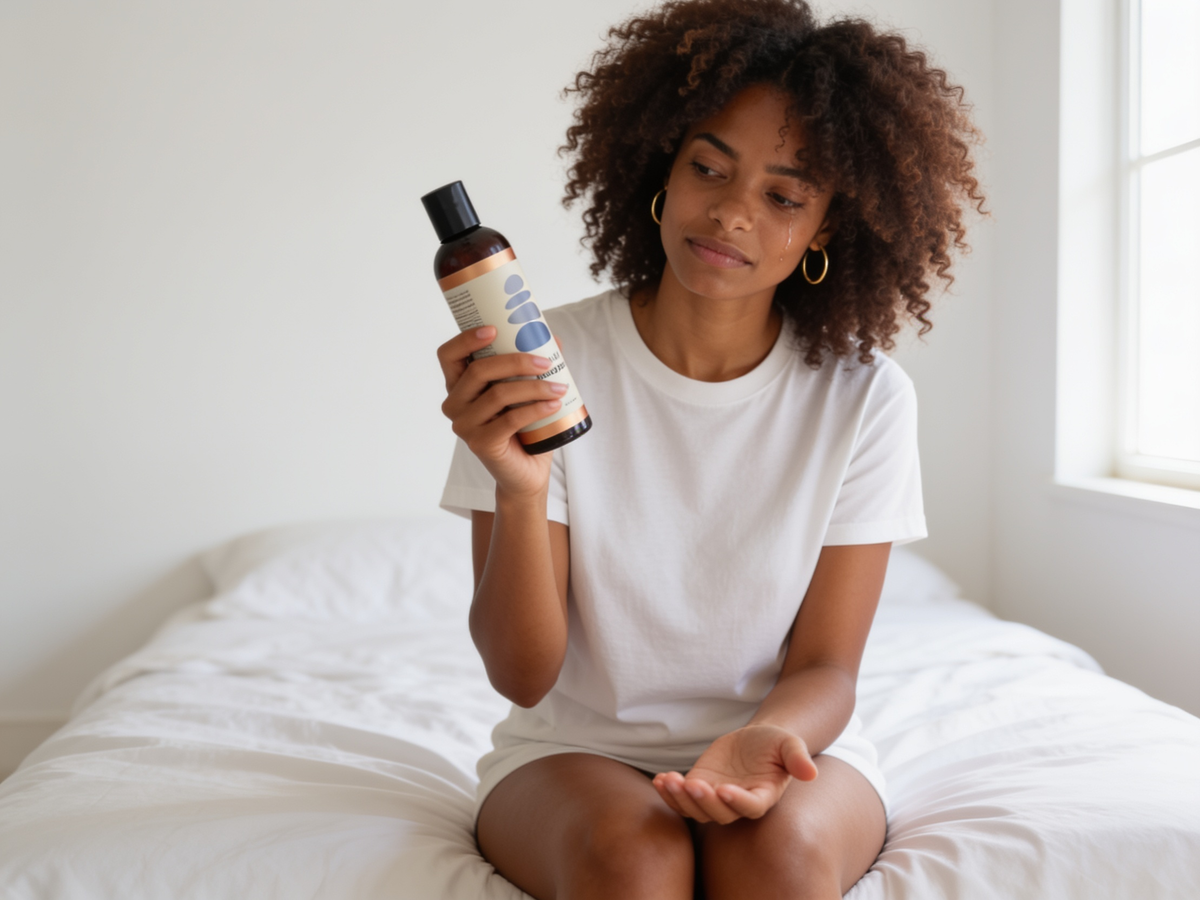
A bottle of massage oil within reach of the bed is one way through that. Oil turns a hand that does not know what to do into a hand with something to do. Slow, on a back or a forearm, asking nothing and going nowhere. What it communicates is company. Someone stayed, their hands are busy, and nothing is being asked of you. The rest of our oils sit in massage oils, and the wider massage and mood shelf is where the candles and balms live.
Then drink some water, and eat something if it is late. Plain comfort, and it costs nothing to offer.
Frequently asked questions
Is it normal to cry after sex?
Yes. In the 2015 Sexual Medicine survey, 46.2 percent of 195 heterosexual Australian university women reported that inexplicable tearfulness or sadness after consensual intercourse had been a problem for them at least a few times in their lives. That is one survey of one population. The authors add a caution of their own: no validated instrument existed for what they were measuring, so they say the prevalence rates need treating with care.
What is postcoital dysphoria?
Postcoital dysphoria names negative feeling that follows consensual sex and is not what the person expected, running past sadness into anxiety, agitation and anger. An associate professor of psychiatry at Weill-Cornell describes it that way in Healthline's piece, as any bad feeling after sex that is not typically expected. The 2015 survey's own item carries the same criterion in the word inexplicable, and it asked whether the feeling had been a problem for the person answering. Postcoital tristesse is a synonym. It stays a described phenomenon rather than a diagnosis, and no page, this one included, can tell you what your own sadness is.
Does feeling sad after sex mean I do not love my partner?
No, on the evidence available. Sadness after sex has not been established as a sign of lost love or a failing relationship, and in the 2015 study the attachment measures the researchers took, anxiety and avoidance, correlated with the symptom and then failed to predict it once the regression ran. What that study did not do is measure love, so it cannot hand your relationship an all-clear either, and Healthline's clinicians do offer relationship explanations among their theories. No established link, no all-clear, and you are better placed to know which it is than any study is.
How long does it last?
Healthline says it can last anywhere from 5 minutes to 2 hours, and gives no source for that span. It describes what is possible, so a longer episode carries no verdict of its own. A low mood that carries on across the rest of your week is the line in the clinician section above.
Can it happen after masturbation, or only with a partner?
Both. Healthline cites a 2020 study finding the symptoms present after general sexual activity and masturbation as well as after consensual partnered sex. Nothing about this requires a second person in the bed.
Does this happen to men?
Yes. Schweitzer, with a new co-author, surveyed it in men in Postcoital Dysphoria: Prevalence and Correlates among Males, in the Journal of Sex and Marital Therapy. Its headline numbers, which come from the abstract and the reporting on it rather than from the paper's own tables: an anonymous international online survey of 1,208 men, 41 percent lifetime and 20.2 percent in the previous four weeks, carrying the same convenience-sample caveat as the women's study. How many experience it regularly is a number worth skipping, because the sources reporting it disagree, from about 3 percent to just over 4.
What should I say to my partner about it?
Say it before it happens, in one sentence, and keep it to what you need: that you go quiet sometimes afterward, that it is not a review of them, and whether you want to be held or left alone when it happens. Agreeing on that in advance removes a conversation that is genuinely hard to have at the time.
When should I see a doctor about feeling sad after sex?
When it happens more often than occasionally, when it is making you avoid sex or straining the relationship, when the low mood is spilling into the rest of your week, when sex brings up memories or panic during it, when sex hurts, or when you did not feel safe or free to stop. And if you are having thoughts of hurting yourself or of not wanting to be here, that needs help today. In the US, call or text 988, and for the safety question RAINN's National Sexual Assault Hotline is 800-656-HOPE (800-656-4673).
Sources
Schweitzer, O'Brien and Burri, Postcoital Dysphoria: Prevalence and Psychological Correlates, Sexual Medicine, 2015, via PubMed Central.
Healthline, Depression After Sex: Why It Happens and What to Do, medically reviewed by Nicole Washington, DO, MPH.

Your AI guide at xdipx.com
Emma is an AI guide to our product catalog on xdipx.com and her job is to find what fits you.
The Notebook, in your inbox.
One send, once-ish a week. Only the ones worth reading. Unsubscribe anytime, we're not needy.