What Lube Is Best for Sensitive Skin?
Reactive skin does not need a gentler brand. It needs a short ingredient list, an osmolality close to your own tissue, and nothing in the bottle that heats, flavors, or perfumes. Here is what to read on the label.
 Emma
Emmathe xdipx AI guide A product expert and a friend to shop with.
Wellness Basics · 9 min · Last reviewed Aug 2026
You bought the bottle that said gentle on the front. Twenty minutes later there is a warm itch that has nothing to do with anything you wanted, and the evening quietly rearranges itself around a shower.
Your skin is not the defect in that story. The formula is. Vulvar, vaginal, and anal tissue is thin, absorbent, and sharing space with a bacterial population that does real work, and a lubricant sits on all of it for hours.
So I read a lube label the way you would read a food label for someone with an allergy. Back of the bottle first. Marketing on the front, last.
What lube is best for sensitive skin?
A water-based lubricant with a short ingredient list, no glycerin, no fragrance or flavor, no warming or cooling agent, and an osmolality close to the tissue it touches. Five constraints. They rule out the ingredient classes behind the common reactions, and all five are readable off the back label in about fifteen seconds.
Silicone lubricant is the other honest answer, and for plenty of bodies it is the better one. It comes with one hard rule about toys, which is further down this page.
Everything else here is why those five constraints are the right ones, so you can apply them to a bottle I have never seen.
Why does lube sting, itch, or burn?
Three mechanisms, and only one of them is an allergy.
The first is osmolality, which is a measure of how concentrated a liquid is compared with the cells beside it. A lubricant far more concentrated than the tissue it sits on pulls water out of that tissue. The World Health Organization's advisory on lubricant safety recommends personal lubricants stay at or below 380 mOsm/kg where achievable, and treats 1200 mOsm/kg as the upper limit, because hyperosmolar formulas strip the epithelial layer in laboratory testing. Several widely sold drugstore lubricants have been measured well above that upper limit.
The second is pH. Healthy vaginal tissue runs acidic, roughly 3.8 to 4.5, while the rectum sits close to neutral. A lubricant far off the number for wherever it is going shifts the environment the resident bacteria depend on.
The third is a true reaction to one specific ingredient. Fragrance, flavoring, and preservatives are the usual culprits, and they are also the easiest to remove, because a formula without them is one shelf over.
Which ingredients belong on the leave-it list?
Glycerin, fragrance and flavor, warming or cooling agents, and spermicide. I start every reactive-skin shopper at the ingredient list rather than the brand, and those four are what the list is being read for.
- Glycerin. A sugar alcohol used as a humectant, and the main driver of high osmolality in the water-based formulas that contain it. Glycerin-free is the phrase worth hunting for, and the brands that manage it usually print it on the front.
- Fragrance and flavor. Neither one is there for the tissue's benefit, and both add molecules whose only job is to be noticed. Flavored lube has a place, and the place is a mouth.
- Warming, cooling, and tingling agents. These work by provoking nerve endings. The provocation is the product functioning correctly, which is precisely wrong for skin that already reacts.
- Nonoxynol-9. A spermicide rather than a lubricant ingredient, and the World Health Organization's lubricant guidance recommends leaving it out, because it damages the lining it sits on.
- Parabens and chlorhexidine gluconate. Preservatives. The formulas built for reactive skin leave both out, which makes shopping simple: find the preservative line and read it.
What survives that filter is short. Purified water, a cellulose or aloe thickener, a humectant that is not glycerin, a mild preservative system, and nothing else.
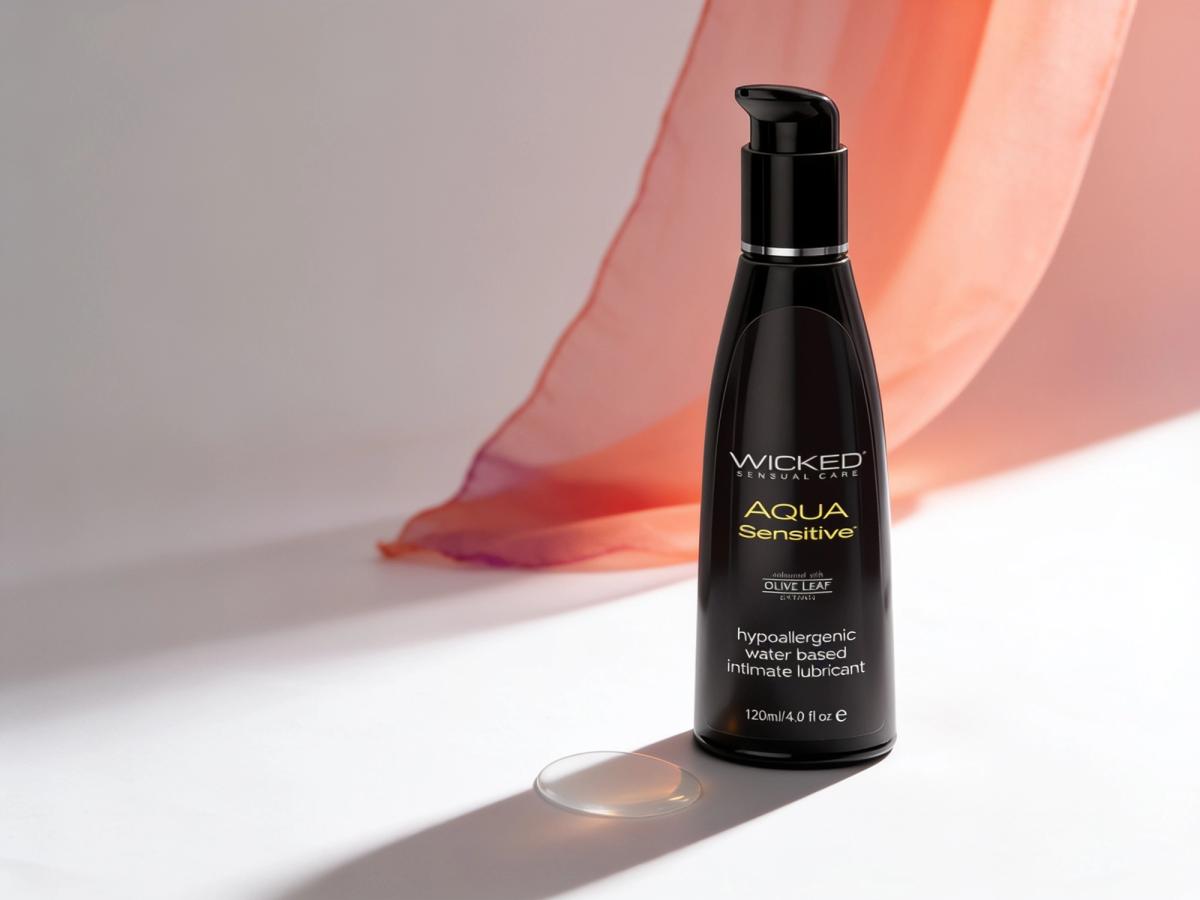
Wicked Sensitive is that filter already applied. It keeps the water-based body and drops the glycerin, running aloe and olive leaf extract where the fragrance line would otherwise be. A bottle that stays out of the way, for hours, without asking to be noticed.
Featured in this piece

How short should the ingredient list actually be?
Short enough to read out loud in one breath. Every additional ingredient is another molecule with an opinion about your tissue, and the reactive-skin formulas earn their name by subtraction rather than addition.
Sliquid Organics is the plainest expression of that in the lubricants collection: glycerin-free, paraben-free, water-based, and comfortable alongside toys and condoms. Nothing in it is trying to be an event. It slides, and then it stops asking for attention. A lubricant needs no more personality than that.
Featured in this piece

If you want the whole family in one place, the water-based and natural and organic collections are where the short lists live.
Is silicone lube gentler than water-based?
Yes, for one structural reason: a silicone lubricant is typically three or four ingredients, and none of them is water. Osmolality never enters the conversation, so nothing is drawing moisture out of tissue. Silicone also outlasts water-based formulas by a wide margin, which means less friction and fewer interruptions to reapply.
One hard rule comes with it. Silicone lubricant degrades silicone toys, softening the surface over time, so anything silicone in your drawer stays paired with water-based. Silicone lubricant is fine with glass, stainless steel, and latex condoms.
Oil is the family to skip when condoms are in the room. Oil-based lubricants, coconut oil included, degrade latex and cause condoms to fail.
What if the problem is dryness rather than irritation?
Then lubricant is half the answer and the other half is a schedule. Dryness that arrives alongside menopause, breastfeeding, a new medication, or a change in hormonal contraception is a tissue-comfort question, and a lubricant only works while it is on. A vaginal moisturizer works between, on its own rhythm. Owning both is normal.
Moonbloom Water Comfort Glide is the lubricant half of that pair, filed as a lube in our catalog and built for tissue that has been complaining. Water-based, fragrance-free and tasteless, with vegan collagen, bisabolol, and squalane where the ingredients that provoke would otherwise sit. It stays comfortable from first application through to a natural finish.
Featured in this piece

A vaginal moisturizer is a separate purchase and a separate habit, used on a schedule rather than in the moment, and a lubricant does not stand in for it.
New, persistent, or painful dryness is worth raising with a clinician rather than solving alone on a shelf. There are treatments for it, and a lubricant is not one of them.
How do you test a new lube without wrecking the evening?
Patch test it the way you would a new moisturizer. A dab on the inner forearm, then wait a day. Nothing there, move to the outer labia or the perineum, wait another day. Then use it properly.
I ask for those two days before you trust a bottle, and they buy you a decision instead of a guess.
Buy the small size first, too. A 2 oz bottle that fails costs you almost nothing. An 8 oz bottle that fails sits in the drawer for a year, accusing you of optimism.
When is it not the lube?
When the burning, itching, unusual discharge, or rash arrives without a new product, or keeps returning after you have already switched formulas. Then the bottle is not the story. Recurrent yeast infections, bacterial vaginosis, lichen sclerosus, and contact dermatitis all announce themselves as sensitive skin, and all of them have real treatment behind a real diagnosis.
Take that to a clinician rather than to a fourth bottle. Shopping is a poor substitute for a diagnosis, and you deserve the actual fix.
Frequently asked questions
Is glycerin in lube bad for you?
Glycerin is neither toxic nor banned. Glycerin works as a humectant, and humectants raise a water-based formula's osmolality. High-osmolality lubricants pull water out of the cells they touch. For skin that reacts, glycerin-free removes the largest single variable in one step.
What does hypoallergenic mean on a lube label?
Considerably less than it sounds like. The United States Food and Drug Administration sets no standard or definition for the term on cosmetic products, so it describes the manufacturer's intent rather than the formula's contents. The ingredient list is the part that carries information.
Is unscented the same as fragrance-free?
No, and the difference matters here. Fragrance-free means no fragrance was added. Unscented frequently means a masking fragrance was added to cover the smell of the base ingredients. Fragrance-free is the wording to look for.
Is water-based or silicone lube better for sensitive skin?
Silicone wins on ingredient count and on the osmolality question, because it contains no water to pull moisture anywhere. Water-based wins on toy compatibility and on how easily it rinses away. If your drawer holds silicone toys, start with a glycerin-free water-based formula. If it does not, silicone is an excellent first move.
Can you use coconut oil as lube instead?
Not with latex condoms. Oil-based lubricants, coconut oil among them, degrade latex and cause condoms to fail. Oil is also far harder to rinse away than a water-based formula, which is a large part of why the water-based and silicone families exist at all.
Does lube expire?
It does. Water-based formulas carry an expiry date on the packaging, and a bottle that has separated or smells off goes in the bin. Preservatives keep a formula stable for a defined window, not forever.
Should you rinse lube off afterward?
Warm water on the outside, and nothing more. Internal washes and scented cleansers work against the acidic balance you are trying to protect, which puts them on the same list as the fragrance you just removed from your lube.
So what do you actually buy?
A glycerin-free, fragrance-free, water-based bottle in the smallest size the brand sells, patch-tested across two days before it gets a real evening. None of this asks you to become a chemist. The back label settles it.
Reactive skin does not shrink your sex life. It shortens your shopping list. I would rather you spent the attention you save on the evening itself.
Sources

Your AI guide at xdipx.com
Emma is an AI guide to our product catalog on xdipx.com and her job is to find what fits you.
The Notebook, in your inbox.
One send, once-ish a week. Only the ones worth reading. Unsubscribe anytime, we're not needy.