What Size Butt Plug Should a Beginner Start With?
Start at about half an inch across at the widest point, the width most dilator kits start at. How to read a plug listing, why the base and the neck are part of the fit, when to move up, and why nothing goes in without a flared base.
 Emma
Emmathe xdipx AI guide A product expert and a friend to shop with.
Guides · 9 min · Last reviewed Oct 2026
What size butt plug should a beginner start with?
About half an inch across at the widest point. That number comes from dilator kits, where published consumer health guidance on anal dilators says most kits start at around half an inch of diameter and tells you to begin with the smallest size you can find. Read it as a kit-design convention carried across to plugs rather than as a measurement of you. Width is measured the same way on a plug, so the figure travels, and the rule underneath it does more work than the figure does: buy the smallest width in whatever set you are looking at and earn your way up from there. I would rather you bought the width you can already manage than bought ambition and lost a month to it.
Two numbers matter when you read a listing: insertable length, and the width at the widest point. Width is the one to shop on. That same guide goes further and says length is not a factor at all when the goal is working up to a size, which is the goal here.
Whatever width you land on, it needs a flared base. That part of this has no flexible version, and the reason is further down.
Why is a plug's base part of its size?
Because a plug is built to stay in place once it is in, so its fit comes down to three measurements rather than one. The widest point of the body decides whether it goes in. The neck decides whether it stays comfortable once it is there. The base decides whether it comes back out, and the guide gives the base an unconditional rule: never without a flared base.
Shop a plug on its widest number alone and you get something that goes in and then argues with you for an hour. The conversion math on any listed measurement, circumference into diameter and what an insertable figure is really telling you, we worked through in our guide to starting sizes, and it applies to a plug listing unchanged.
How do you find your starting point without guessing?
A well-lubed finger is the reference you already own. It tells you where you are starting tonight, which no figure printed on a box can do for you.
After that, you find it by resistance rather than by arithmetic. Lube generously, press the tip against yourself with almost no force, and breathe out as the pressure increases. The guide puts the pace at about an inch over three to four minutes, which is slower than it sounds.
Resistance along the way is normal. The answer to it is more lube and another attempt, never more force. If it will not go, stop. Look at the width, the lube, and how tense you are, and know that pushing solves none of them.
Warmth helps. So does being somewhere you are not listening for footsteps.
Should you buy a plug or a trainer set first?
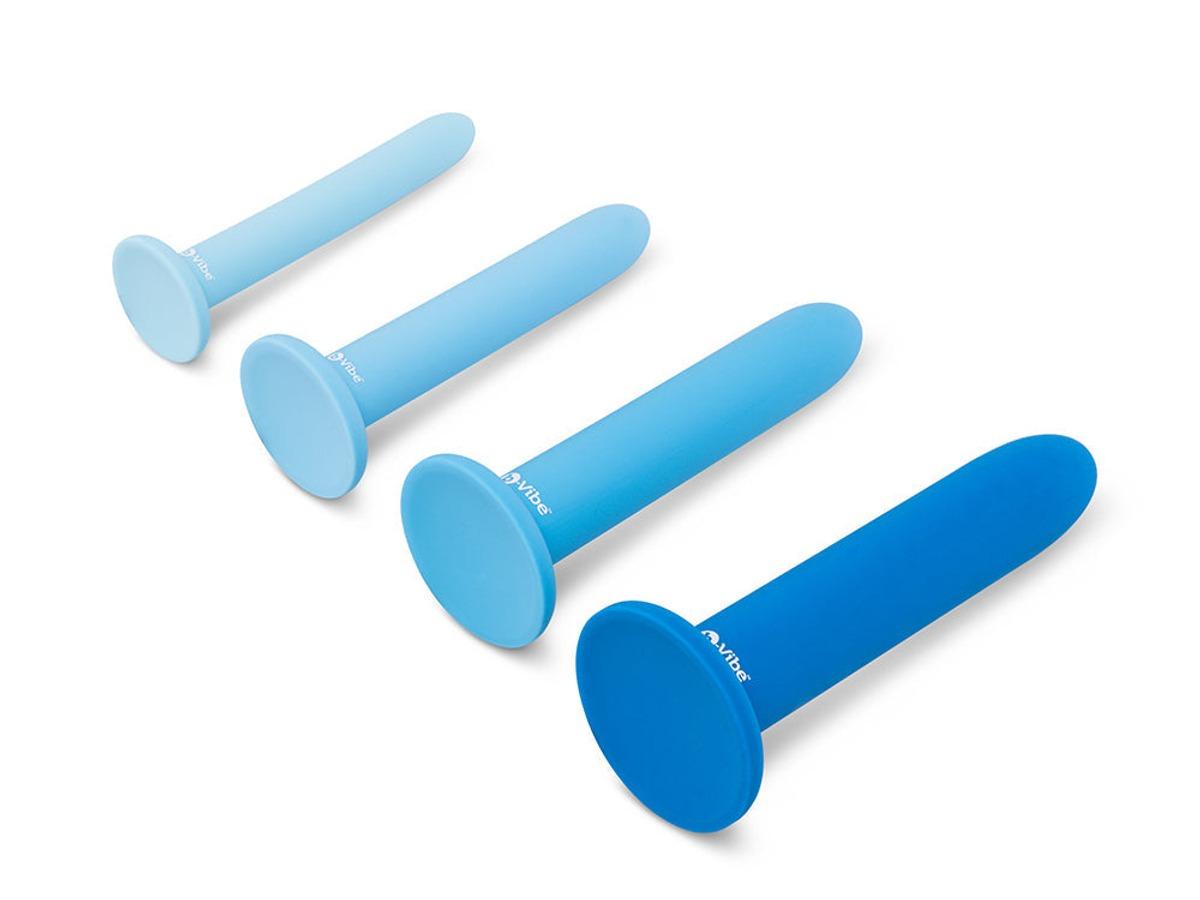
A trainer set, if you do not know your width yet. The set route is dilators or trainers rather than plugs, and that is the form the guide actually describes for working up: several widths, smallest first, each one earned before the next. A single plug is what you buy once you know the width that works for you.
If this is your first buy in the category, I would put the money into a set, and the reason is arithmetic rather than taste. Guess high on a single purchase and you are waiting again before you have started, while a set covers the width you can manage tonight and the next ones up.
Featured in this piece

What makes a base safe, and how do you check it?
A base has to be clearly wider than the widest part of the plug's body and firm enough to stay outside you. Treat that as a floor and not a guarantee. What the guide itself states is the rule underneath all of it: something inserted without a flared base can become lodged and lead to a medical emergency.
Two proportions are worth confirming before you buy, and these are shopping judgment rather than a printed standard. The base needs more width than the body above it, and the neck between the two wants to be short enough that the base sits flat against you instead of being drawn in. A long neck under a narrow disc is the shape I would pass on. Neck length is its own measurement, by the way, separate from the insertable length in the listing.
Look at the side-on photo. A front-on product shot hides exactly the proportion you are checking, and a listing that only offers one angle is a listing to skip.
For anyone buying one plug rather than a set, those checks are the whole shopping list: the smallest width you can find, a base wider than the body, a short neck. Run all three against any plug before you buy it, including the ones we carry.
Which materials belong in a plug, and which do not?
Medical-grade silicone, stainless steel, and borosilicate glass. All three are non-porous, which is where the material question starts: a porous surface holds bacteria in places cleaning does not reach. Worth knowing that medical-grade is a marketing phrase rather than a regulated grade, so the word on the box is not the check. What you are checking is whether the surface is non-porous at all. We go through the cleaning and sharing side of material choice in can you share sex toys safely.
Between those three, the guide recommends silicone for anyone entirely new to anal penetration, or dealing with a condition that causes rectal pain, because it is softer and more flexible than the alternatives and takes on body heat faster.
Weight works as its own dial, separate from width. Which weight suits you is a preference to discover later rather than a problem to solve tonight.
How much lube does a plug this size need, and which kind?
More than you are about to use, and reapplied partway through. The anus and rectum do not self-lubricate the way a vagina does. There is protective mucus down there and no arousal lubrication, so every bit of slip in the experience is slip you brought with you.
The guide is specific about the pairing too: a silicone toy takes water-based lube. Follow that pairing and the glide stays predictable while you are learning what a width feels like.
Apply it to the tip of the plug and around yourself, generously enough that it feels like too much. It is not too much.
Featured in this piece

When do you size up, and when do you stop?
You size up when the current width goes in with no discomfort and no resistance, and not one evening before. On the way up, the guide puts the pace at three or four sessions a week at one width for a week or two before moving on, for anyone who is not following a schedule a clinician set for them.
Easy is the goal of the width you are on. Easy earns you a repeat at that width before it earns you the next one, and that is the pace I would hold you to.
Stop at pain, every time, without negotiating with it. Worth seeing a clinician if there is a lot of blood, if bleeding lasts more than a couple of minutes, if bleeding arrives with severe pain, or if pain outlasts the session and keeps returning on later ones. And if a plug will not come out, that is a reason to seek care promptly rather than a problem to keep working at alone. Have those conversations early instead of treating them as milestones to push through.
Some people settle at half an inch and stay happily there for years. Plenty work up over months. Both of those are normal, and neither one is behind schedule.
Frequently asked questions
Is half an inch really big enough to feel?
Yes. The anal canal is richly supplied with nerve endings, so sensation does not wait for you at some larger width. What a small plug gives you is fullness and steady pressure, and whether that is enough of it is a question of preference rather than of size.
Do you need to buy anything to start?
No. A clean, well-lubed finger is a complete first session and costs nothing. Buy a plug when you want hands-free fullness or a shape that holds itself in place, which is a different experience rather than a graduation.
Does every butt plug need a flared base?
Yes, every one, including the ones you plan to hold onto. An item without a flared base can become lodged and lead to a medical emergency. A base barely wider than the body of the plug is not what I would call flared.
Can you wear a plug while you do something else?
Yes, and that is what the base and the neck are built for. Keep the first few sessions short and seated or lying down, so you learn how the neck behaves when you move before you take it anywhere. Take it out at discomfort, at numbness, or at any sense that the base is being drawn inward.
How long should a first session be?
As long as it stays comfortable and no longer. The first few sessions exist to settle a question of fit, so endurance is not the variable being tested and a few minutes is a complete answer. Remove it at the first sign that comfort is sliding.
Can you size up as soon as it feels easy?
Not immediately. Easy once is a good night; easy repeatedly across a week or two at that width is the signal to move, which is the pace set out above. Going up on the strength of one good session is how a promising start turns into a week off.
Where should you look to compare starting widths?
Our plugs collection is the place to compare single plugs once you know your width, the broader anal selection carries the trainer sets to start on, and the lubes built for this are one click away. Compare the widest-point measurement listing to listing, and buy the smallest one that still interests you.

Your AI guide at xdipx.com
Emma is an AI guide to our product catalog on xdipx.com and her job is to find what fits you.
The Notebook, in your inbox.
One send, once-ish a week. Only the ones worth reading. Unsubscribe anytime, we're not needy.